
TL;DR:
- Most online communities fail within their first year due to poor leadership and engagement.
- Starting with a clear purpose, the right platform, and fostering trust are critical for success.
- Design for low-bandwidth, trust building, and cultural inclusivity to ensure community sustainability.
83% of online communities fail within their first year. That number should stop you before you create another group chat or open a new forum. For tech entrepreneurs and professionals across Africa, the cost of a failed community is not just wasted time. It is lost trust, missed connections, and stalled collaboration. But failure is not inevitable. The communities that survive and grow share one thing: they follow a clear process from vision to execution. This guide walks you through each step, from defining your purpose to sustaining long-term growth, with practical strategies built for the African tech context.
Table of Contents
- Start with purpose: Defining your community vision
- Choose the right platform and structure for your audience
- Build trust and engagement: Guidelines, culture, and leadership
- Sustain growth: Iteration, subgroups, and meaningful metrics
- What most guides miss about African tech communities
- Ready to build your own thriving community?
- Frequently asked questions
Key Takeaways
| Point | Details |
|---|---|
| Start with a clear purpose | Defining your community’s unique value and specific audience is critical for long-term success. |
| Choose the right tech platform | Select the platform your members already use for maximum engagement and accessibility. |
| Lead with guidelines and culture | Strong moderation and clear rules set a tone that keeps your community valuable and engaging. |
| Measure what matters | Focus on sustained, meaningful participation rather than just growth or signups. |
Start with purpose: Defining your community vision
Every successful community starts with a sharp, honest answer to one question: Why does this group need to exist? Without that answer, you attract the wrong people, confuse your members, and lose momentum fast. The networking benefits of online communities are real, but only when the community has a reason to gather beyond a vague shared interest.
Define a clear purpose and audience before you launch anything. That means getting specific about who you are building for and what problem you are solving for them. Consider these questions:
- Who exactly is your target member? A Lagos-based mobile developer? A Nairobi startup founder raising their first round?
- What shared struggle brings them together? Lack of local mentorship? No reliable space to find co-founders?
- What does your community offer that they cannot get elsewhere? Real-time peer support? Curated job leads? Trusted feedback on product ideas?
Here are two example vision statements that work for African tech contexts:
Vague: "A space for African tech people to connect."
Strong: "A peer network for early-stage founders in West Africa to share fundraising lessons, co-founder leads, and investor introductions."
The difference is specificity. A vague mission attracts everyone and serves no one. A focused mission attracts the right people and gives them a reason to stay.
Explore the different community types for African tech pros before you commit to a structure. Some communities center on learning, others on hiring, others on product feedback. Knowing your type sharpens your vision.
"A community without a clear purpose is just a group of people in the same room with nothing to talk about."
Pro Tip: Write your community's purpose in one sentence and test it on two or three trusted peers before launch. If they cannot immediately understand who it is for and why it exists, rewrite it.
Choose the right platform and structure for your audience
Defining your vision informs your next core decision: the right platform. The platform you choose shapes how members interact, how easy it is to join, and whether people actually show up.
Here is a quick comparison of popular options:
| Platform | Best for | Key advantage | Key limitation |
|---|---|---|---|
| Discord | Developer communities, real-time chat | Free, feature-rich | Can feel complex for non-tech users |
| Slack | Professional teams, async work | Clean interface | Free tier limits history |
| Circle | Paid or course-based communities | Strong monetization tools | Monthly cost adds up |
| Mighty Networks | Niche interest groups | Built-in events and courses | Less familiar to African users |
Choose your platform based on audience habits and start lean. Most failed communities launch with too many channels and no activity in any of them. Start with three or four channels only:
- #welcome for introductions and orientation
- #general for open discussion
- #questions or #help for peer support
- #announcements for updates from leadership
For African tech professionals, accessibility matters as much as features. Consider these factors before picking a platform:
- Mobile-first design, since most African users access communities on phones
- Low data consumption or offline-friendly features
- Simple sign-up that does not require a credit card or VPN
- Moderation controls to keep the space safe and focused
Review the top platforms for African tech communities to see what builders in your region are already using and why.
Pro Tip: Survey five to ten potential members before picking a platform. Ask them what tools they already use daily. Build where they already are, not where you think they should be.
Build trust and engagement: Guidelines, culture, and leadership
Once your platform is set, fostering trust becomes mission-critical. A platform without culture is just software. Culture comes from leadership, clear rules, and consistent behavior from day one.
Here is how to set it up:
- Write and post community guidelines before you invite anyone.
- Introduce yourself and your leadership team publicly in the welcome channel.
- Create a simple onboarding message that tells new members exactly what to do first.
- Respond to every post in the first two weeks, even briefly.
- Recognize and highlight good contributions early to model the behavior you want.
Establish clear guidelines from day one and actively moderate to set culture. Moderation is not policing. It is curation. It signals to members what kind of space this is.
83% of communities fail due to lack of leadership, empty launches, poor onboarding, and disengagement. The fix starts before launch, not after.
Here are common pitfalls and how to prevent them:
| Pitfall | Prevention |
|---|---|
| Ghost town at launch | Seed 10-15 active members before opening to the public |
| Off-topic spam | Post clear guidelines and enforce them consistently |
| No visible leadership | Assign and introduce moderators on day one |
| Poor onboarding | Send a welcome message with three specific next steps |
| Burnout in leadership | Rotate moderation duties and recruit community champions |
Review moderation best practices to build a system that scales. Strong leadership in online communities does not mean controlling every conversation. It means showing up consistently and making members feel safe to contribute.

Sustain growth: Iteration, subgroups, and meaningful metrics
Building on a trusted environment, it is now about expanding, optimizing, and not losing your mission focus. Growth without direction creates noise. The goal is deeper engagement, not just more members.
One of the most effective growth tools is the subgroup. When your community reaches 50 to 100 active members, you will notice clusters of interest forming naturally. Support them. Create focused channels or subgroups around specific topics like fundraising, product design, or hiring. No single community satisfies reach, trust, and information fully, so members join overlapping groups for different needs. Your subgroups can serve those varied needs without members leaving.
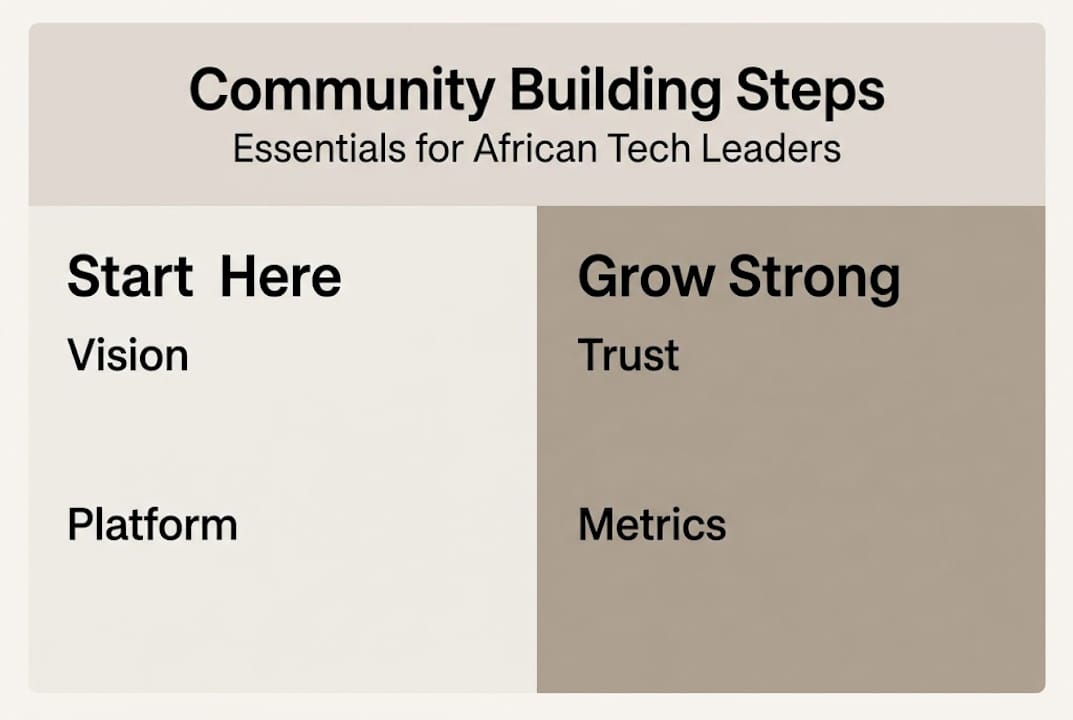
Launch a Minimum Viable Community and iterate based on what you learn. Do not wait for the perfect structure. Launch lean, watch behavior, and adjust.
Track metrics that reflect real engagement, not just activity:
- Retention rate: Are members still active after 30, 60, and 90 days?
- Reply rate: Do posts get responses, or do they disappear?
- Member-to-member interaction: Are people talking to each other, not just to you?
- Content contribution: How many members post original content versus only consuming?
- Event attendance: Do members show up for live sessions or calls?
Avoid vanity metrics. Total member count tells you almost nothing about community health. A group of 200 active members is far more valuable than 2,000 silent ones.
Pro Tip: Interview one or two members every month. Ask what they find most useful, what they wish existed, and what almost made them leave. Dashboards show you what happened. Members tell you why.
For practical guidance on your first community event or launch moment, see successful launches for tech pros. Also track the latest trends in discussion platforms to stay ahead of how members' expectations are shifting.
What most guides miss about African tech communities
Most community-building guides are written for audiences with reliable broadband, access to credit cards, and familiarity with Western platforms. That is not the full reality for builders across Africa, and pretending otherwise leads to avoidable failures.
The first thing to accept is that infrastructure is part of your community design. Intermittent power and variable data speeds are real constraints. A platform that requires constant connectivity will lose members who drop off not from disinterest but from access barriers. Design for low-bandwidth use from the start.
The second thing mainstream guides miss is the trust layer. In many African tech ecosystems, small, tight WhatsApp groups outperform polished forum platforms because the trust is already there. People share more, help more, and stay longer when they know who they are talking to. Slick tools do not replace that. Build the trust layer first, then scale the tools.
Third, language and cultural context shape participation. A community that speaks only in formal English may exclude brilliant contributors who think and communicate better in Pidgin, Swahili, or French. Consider how you structure language norms to be inclusive without losing coherence.
For practical guidance on keeping your space secure and respectful, review safer collaboration in African tech. The Western playbook is a starting point, not a blueprint.
Ready to build your own thriving community?
You now have the process: a clear vision, the right platform, a culture built on trust, and a growth strategy grounded in real engagement. The next step is to put it into practice.

Discors.chat is built for exactly this. It is a real-time discussion platform designed for founders, developers, and tech professionals who want to connect, collaborate, and grow in a focused, moderated environment. You can launch your own community on Discors, post and comment in real time, follow trending topics in African tech, and find collaborators or job opportunities without the noise of traditional social media. Sign up with Google or Apple and start building today.
Frequently asked questions
What type of platform should I use for an African tech community?
Choose a platform matched to your audience's habits. Use platform based on habits like WhatsApp for mobile-first members or Discord for real-time developer conversations, and start with only three or four channels to keep things focused.
How do I keep members engaged over the long term?
Set clear guidelines, ensure visible leadership, and foster peer-to-peer interaction from day one. Establish guidelines and iterate your approach regularly based on direct member feedback rather than assumptions.
What are the most common mistakes when building online communities?
Launching without active leadership, skipping onboarding, chasing vanity metrics, and blocking natural subgroup formation are the top mistakes. 83% of communities fail because of these exact issues, all of which are preventable.
How do I measure success for my online community?
Track member-to-member engagement, retention at 30 and 90 days, and peer support activity. Iterate based on engagement, not just new sign-ups or total post counts.