
Most online communities fail quietly. Only 15% of members stay active beyond 120 days, and that number is even harder to sustain when a platform was not built with your specific context in mind. For African tech professionals and the diaspora, the gap between joining a platform and actually getting value from it is wide. Generic networks offer noise. What you need is structure, safety, and real professional connection. This guide breaks down what business community platforms actually are, which features drive engagement, and how to choose and apply the right one for your goals.
Table of Contents
- What defines a business community platform?
- Key features and mechanics for engagement
- Nuances for African tech and diaspora professionals
- Choosing and applying the right platform
- Rethinking business community platforms for real impact
- Connect, collaborate, and grow your business community
- Frequently asked questions
Key Takeaways
| Point | Details |
|---|---|
| Clear platform definition | Business community platforms prioritize ownership, engagement, and specialized features over generic networks. |
| Engagement mechanics matter | Features like live events, onboarding, and analytics dramatically improve participation and retention. |
| Africa-focused adaptation | Mobile-first, safe, and low-data designs are essential for African tech professionals and the diaspora. |
| Quality over quantity | Deeper, integrated communities deliver more value than joining many superficial groups. |
| Practical decision framework | Use benchmarks and context-specific criteria to choose and build your business community platform. |
What defines a business community platform?
A business community platform is not just a place to post updates. It is a structured digital environment designed to support professional interaction, knowledge sharing, and collaboration around specific goals or industries. That distinction matters. A general social network is built for broad reach. A business community platform is built for depth.
Think of the difference this way. LinkedIn is a directory with a feed. A business community platform is closer to a professional club with rules, roles, and recurring conversations. The goal is not to collect followers. It is to build networking success in communities that compound over time.
According to platform research, key mechanics include threaded discussions, member profiles, events, moderation tools, gamification, analytics, and integrations. These are not optional extras. They are the infrastructure that keeps a community alive past the first 90 days.
Here is how business community platforms compare to general platforms:
| Feature | Business community platform | General social platform |
|---|---|---|
| Ownership of data | Yes, full control | Limited or none |
| Moderation tools | Built-in, customizable | Basic or absent |
| Member analytics | Detailed dashboards | Minimal |
| Onboarding flows | Structured and guided | Generic sign-up |
| Discussion threading | Deep, topic-based | Flat or algorithmic |
| Event management | Integrated | Add-on or absent |
The core methodologies that make these platforms work include:
- Value-first engagement: Members must receive something useful before they are asked to contribute.
- Structured onboarding: New members need a clear path into the community, not a blank homepage.
- Moderation with purpose: Rules are enforced not to restrict, but to protect the quality of interaction.
- Integration with existing tools: Platforms that connect to calendars, messaging apps, or professional profiles see higher sustained use.
For African tech professionals, these business platform features are especially important because the stakes of a poor platform experience are higher. Time is limited. Connectivity is not always reliable. Every interaction needs to count.
Key features and mechanics for engagement
Knowing what a platform is and knowing what makes it work are two different things. Features do not drive engagement on their own. The way they are implemented and combined is what creates active communities.
The data is clear. Integrated features boost logins by 124% and increase discussions by 50%. That is not a small improvement. It means the difference between a community that hums with activity and one that goes silent after launch week.
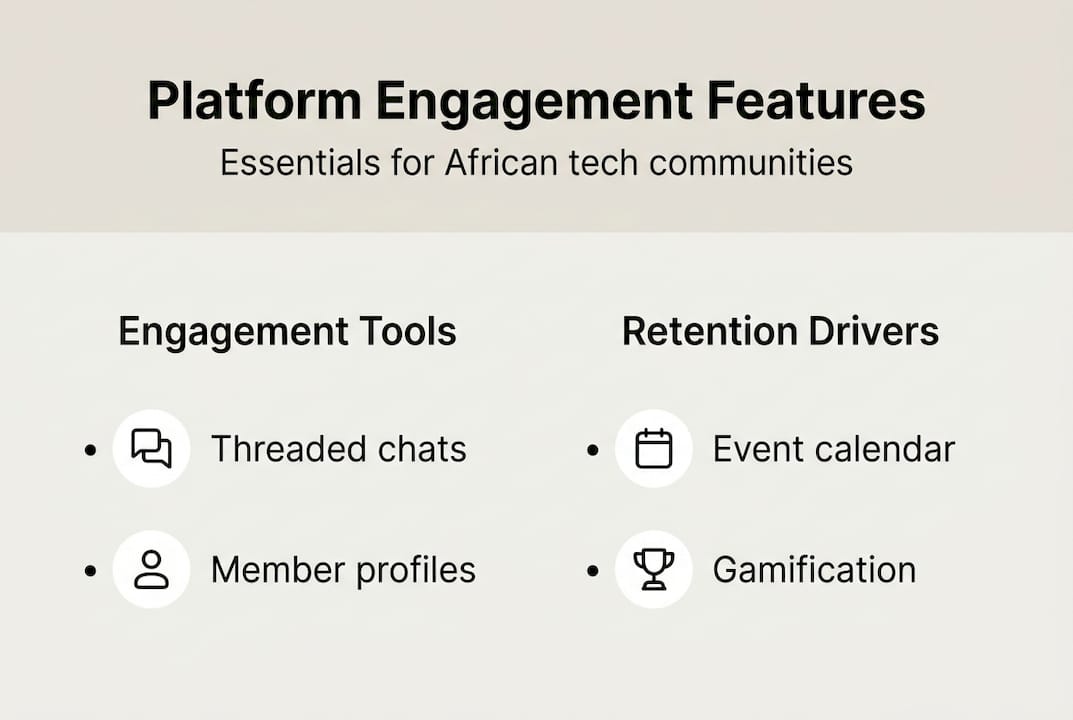
Here is a breakdown of the features with the strongest impact on engagement:
| Feature | Engagement impact | Why it matters |
|---|---|---|
| Personalized onboarding | High | Reduces early drop-off |
| Email digests | Medium-high | Brings inactive members back |
| Gamification (badges, points) | Medium | Rewards consistent participation |
| Analytics dashboards | High for admins | Identifies what content works |
| Threaded discussions | Very high | Enables focused, deep conversation |
| Event integrations | High | Creates recurring reasons to return |
"The platforms that sustain engagement are the ones that give members a reason to come back tomorrow, not just today." This is the core principle behind every high-performing community tool.
For community managers and founders, tracking platform engagement benchmarks helps you know if your community is healthy. A good benchmark: aim for 20% of members posting or commenting monthly, and 40% opening weekly digests.
The features that matter most for African tech communities specifically include:
- Real-time discussion threads: Fast, async conversations that do not require everyone to be online at once.
- Moderation tools: Essential for safety. Review moderation strategies for communities to understand how to keep discussions productive.
- Mobile-optimized interfaces: Most African users access platforms via mobile. A desktop-first design is a barrier.
- Low-bandwidth modes: Slower connections should not mean a worse experience.
- Topic-following and discovery: Members need to find relevant conversations without scrolling through noise.
Staying current on 2026 platform trends also helps you anticipate which features will matter most as your community scales.
Nuances for African tech and diaspora professionals
Engagement mechanics are universal. But the context in which they operate is not. African tech professionals and diaspora communities face specific conditions that most platform guides completely ignore.

Digital divides mean mobile-first and low-data features are not optional for African audiences. They are the baseline. A platform that loads slowly on a 3G connection or requires constant video streaming will lose users before they ever see the value.
Beyond infrastructure, the social dynamics of professional networking in African and diaspora contexts are distinct. Research shows that introverts thrive via online depth, B2B professionals prioritize utility over social interaction, and roughly 85% of community members are lurkers who derive real value without ever posting. This means your platform needs to serve people who read but do not write, just as well as it serves active contributors.
Key nuances to account for when building or choosing a platform for this audience:
- Safety and vetted matchmaking: Open, unmoderated spaces create risk. Tiered access and verified profiles reduce spam and bad actors.
- Tiered membership: Not everyone needs the same level of access. Separating public discussions from private professional groups gives members control.
- Automation for follow-up: Automated digests, reminders, and suggested connections reduce the manual effort required to stay engaged.
- Analytics tailored to context: Knowing which topics resonate in Lagos versus London helps community managers serve both audiences well.
- Onboarding that reflects local realities: Asking for a LinkedIn profile as the only verification method excludes many valid professionals who are not active on Western platforms.
For deeper context on building for this audience, see platforms for African tech entrepreneurs and how moderated networking for innovation works in practice.
Pro Tip: If you are building a community for African tech professionals, run a short survey in the first 30 days asking members how they access the platform and what their biggest barrier to participation is. The answers will reshape your onboarding and feature priorities fast.
Choosing and applying the right platform
With context-specific needs explained, it is time for practical guidance on choosing and using the right platform. The wrong choice here costs you time, members, and credibility.
Here is a step-by-step framework for selecting and launching a business community platform:
- Define your community's core purpose. Is it peer support, deal flow, hiring, or knowledge sharing? A single clear purpose drives better feature choices.
- Audit your audience's tech access. What devices do they use? What is their average connection speed? This shapes your mobile and data requirements.
- Prioritize ownership. Integrate with LinkedIn for reach, but own your data for long-term control. Platforms that lock you out of your own member data are a liability.
- Start small and moderated. Launch with 50 to 100 vetted members before opening broadly. Quality early members set the tone.
- Build in recurring value. Weekly digests, monthly events, or regular expert sessions give members a reason to return.
- Track and adjust. Use analytics to see what is working. Drop what is not. Communities that adapt survive.
For practical steps on getting started, review launching discussions for African tech professionals and how career growth with discussion platforms happens over time.
Common mistakes to avoid:
- Launching without a moderation plan.
- Chasing member count instead of member quality.
- Ignoring mobile experience in favor of desktop design.
- Relying entirely on a third-party platform without data ownership.
Pro Tip: Platforms that reduce reliance on external support channels can cut support costs by 10 to 25% and boost retention through peer utility. Build peer-to-peer help into your community from day one.
Focus on 2 to 3 relevant communities rather than spreading across every platform. Depth beats breadth every time when it comes to professional networking that actually moves your career or business forward.
Rethinking business community platforms for real impact
Most guides on this topic tell you to be consistent, post regularly, and engage authentically. That advice is not wrong. It is just incomplete.
The bigger issue is that most professionals default to broad, generic platforms because they are familiar. LinkedIn has reach. Twitter has noise. Neither was built for the specific professional realities of African tech founders or diaspora professionals navigating two or more markets at once.
Deep engagement yields bigger retention gains than broad reach. That is the uncomfortable truth most platform guides skip past. A community of 300 active, relevant professionals will do more for your career or business than a network of 10,000 passive followers.
Ownership matters too. When a platform shuts down or changes its algorithm, you lose everything you built if you do not own your member data. This is not a hypothetical risk. It has happened repeatedly across major platforms.
For African tech and diaspora professionals, the practical lesson is this: prioritize platforms that are mobile-first, safety-conscious, and built for professional depth. Track your own analytics. Moderate your own spaces. And invest in growth in professional communities that reflect your actual goals, not just the platforms everyone else is using.
The 85% who lurk are not disengaged. They are learning. Build for them too.
Connect, collaborate, and grow your business community
Building a business community that stays active and relevant takes the right tools and the right environment. Discors.chat is designed exactly for this.

Discors offers a real-time discussion platform built for African tech professionals, founders, developers, and diaspora innovators. It combines moderated discussions, topic discovery, real-time chat, and community building in one focused space. No algorithmic noise. No data lock-in. Just direct, meaningful professional interaction. Whether you want to start a business community, find collaborators, share what you are building, or explore trending conversations in tech and startups, Discors gives you the tools to do it safely and effectively. Sign up with Google or Apple and start connecting today.
Frequently asked questions
What makes a business community platform different from general networking sites?
Business community platforms offer ownership, deeper integrations, and specialized features like onboarding, moderation, and analytics. General platforms lack ownership and data control compared to dedicated community tools.
How do African tech professionals ensure safe and scalable communities?
Prioritize vetted matchmaking, tiered access, moderation tools, mobile-first design, and low-data features. Safe platforms for African tech diaspora should tailor these functions to regional connectivity challenges.
Which features boost engagement and retention most strongly?
Integrated events, personalized onboarding, email digests, analytics dashboards, and gamification drive the most impact. Integrated features boost logins by 124% and increase active discussions by 50%.
Is it better to join many platforms or focus on a few?
Quality beats quantity. Focus on 2 to 3 deep, relevant communities rather than spreading thin across broad networks for stronger connections and better retention.