
TL;DR:
- Structured community platforms outperform open social media for professional networking in Africa.
- Enhanced moderation, privacy controls, and fintech integration enable safer, more focused collaboration.
- Small, vetted, and purpose-driven communities lead to better mentorship, monetization, and career growth.
Social media was never built for serious tech collaboration. Yet millions of African founders, developers, and tech professionals still rely on noisy group chats and open feeds to network, share ideas, and find opportunities. That approach is breaking down. With 643 active tech hubs now operating across the continent, the infrastructure for focused, moderated community platforms is catching up fast. This article covers why specialized platforms outperform open social media for professional networking, what features matter most, how moderation and privacy protect your work, and what real outcomes look like for founders and developers who make the switch.
Table of Contents
- Why community platforms matter for African tech
- Unique features and mechanics driving African tech communities
- The mechanics of moderation and privacy in professional spaces
- Real-world impact: Monetization, learning, and collaboration at scale
- Rethinking the future: What most founders and tech pros get wrong
- Take your collaboration further: Try a privacy-first platform
- Frequently asked questions
Key Takeaways
| Point | Details |
|---|---|
| Privacy and moderation | Effective, privacy-focused moderation turns online communities into productive professional spaces. |
| Monetization potential | New platforms let African tech pros earn through learning, mentorship, and fintech integration. |
| Scalable collaboration | AI-human hybrid tools enable large-scale, safe, and focused tech collaboration across the continent. |
| Local optimization | Platforms tailored for low-data and mobile use reach diverse users, including the diaspora. |
| Quality over size | Curated, aligned communities offer deeper benefits than massive, unmoderated groups. |
Why community platforms matter for African tech
Open social media was designed for reach, not depth. When you post a technical question on a general platform, you get noise. Irrelevant replies, promotional spam, and off-topic threads crowd out the signal. For founders and developers trying to solve real problems, that noise is costly.
Structured community platforms solve this by design. They organize conversations into focused boards, apply moderation rules, and gate access so only relevant professionals participate. The result is a space where trust builds faster and shared resources actually get used.
Privacy is a core part of that trust. When professionals know their ideas are visible only to vetted peers, they share more freely. That openness drives better collaboration, faster problem-solving, and stronger professional relationships over time.
As one community builder put it, grassroots communities offer intimacy but risk burnout, while sponsored ones scale but lose depth. That tradeoff is real. The best platforms find a middle path: structured enough to scale, personal enough to stay meaningful.
Here are the core benefits that focused community platforms deliver for African tech professionals:
- Focus: Conversations stay on-topic because boards and filters keep discussions organized
- Safety: Moderation and vetting reduce harassment, spam, and low-quality content
- Monetization: Integrated fintech and paid mentorship features create earning opportunities
- Career growth: Peer learning, job boards, and direct networking accelerate professional development
- Privacy: Closed groups and access controls protect sensitive ideas and early-stage projects
These benefits are not theoretical. They translate directly into networking and growth opportunities that open platforms simply cannot replicate. Understanding the types of online communities available helps you choose the right fit for your goals.
Unique features and mechanics driving African tech communities
African tech communities face challenges that platforms built for North American or European users do not account for. Inconsistent internet connectivity, mobile-first usage patterns, and the need for fintech integration all shape what a useful platform looks like here.
Low-data optimization is one of the most important design choices. Platforms that compress content, reduce image load, and support offline reading serve users across Lagos, Nairobi, Accra, and Kampala far better than data-heavy alternatives. This is not a minor feature. It is a prerequisite for real adoption.
Owllup, with 5,000+ users, integrates mentorship, learning communities, and fintech directly into its platform. Users can earn from their expertise while building professional networks. That combination of social connection and financial utility sets African-focused platforms apart from generic alternatives.
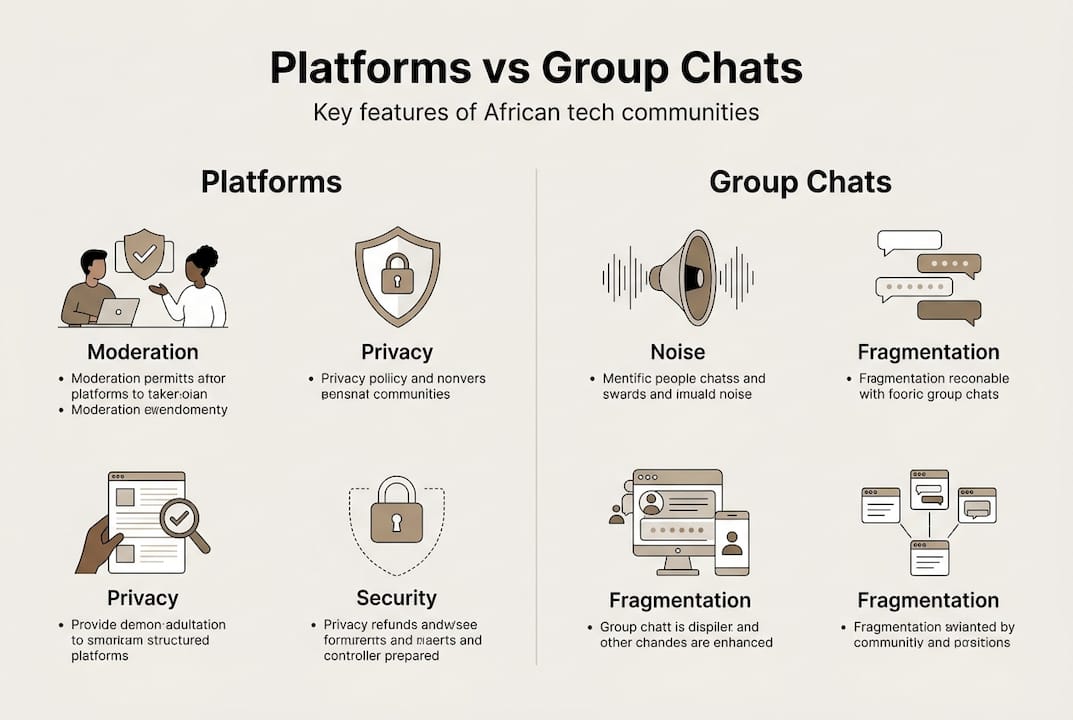
The table below compares structured community platforms against unstructured group chats across key mechanics:
| Feature | Structured community platform | Unstructured group chat |
|---|---|---|
| Moderation | AI-human hybrid, rule-based | Minimal or manual only |
| Content organization | Boards, tags, filters | Chronological feed only |
| Privacy controls | Closed groups, vetting | Basic admin controls |
| Fintech integration | Payments, paid mentorship | None |
| Noise level | Low | High |
| Scalability | High | Breaks at scale |
Structured boards and filters reduce noise compared to unstructured groups and integrate with fintech for earning, making them a practical upgrade for any serious professional.
Diaspora communities add another layer. African tech professionals in London, Toronto, and Houston want to stay connected to opportunities back home. Platforms that serve both local and diaspora users expand the talent pool and funding network available to every member.
Pro Tip: Choose platforms that let you control your privacy settings and earning potential separately. A platform that forces you to go public to monetize your knowledge is not actually working in your favor. Look for discussion platforms that give you both options at once. Platforms built for real-time discussions with strong privacy defaults are the ones worth your time.
The mechanics of moderation and privacy in professional spaces
Group chats work fine at 50 members. At 500, they collapse. Conversations fragment, bad actors slip through, and the signal-to-noise ratio drops until most serious professionals stop participating. This is not a people problem. It is a mechanics problem.
Scalable moderation solves it. AI-human hybrid systems, like those used by platforms such as Hive and Two Hat, enable scalable real-time review for chats and posts, keeping focused discussions clean without requiring a full-time moderation team. The AI handles volume. Human moderators handle nuance.
Privacy features work alongside moderation to create safe collaboration spaces. Three tools matter most:
- Closed groups: Only approved members can view and participate, protecting early-stage ideas from public exposure
- Member vetting: Applications, referrals, or credential checks filter out bad actors before they enter
- Regular audits: Periodic reviews of member activity catch problems before they escalate
These are not optional extras for professional communities. They are the foundation.
The numbers back this up. With 643 active tech hubs across Africa fostering collaboration, the demand for safe digital spaces that mirror the trust of in-person hubs is growing fast. Nigeria's developer community alone has been growing at 28% year over year, adding thousands of new professionals who need structured spaces to connect and learn.
Here is how moderation enables safe collaboration in practice:
- A new member applies and is vetted against basic professional criteria
- AI tools scan incoming posts for spam, harassment, and off-topic content
- Human moderators review flagged content and enforce community guidelines
- Members report issues through clear, accessible channels
- Moderators act within defined timeframes, keeping the community responsive
This process is what separates a platform you can trust from one you eventually abandon. Launching moderated online discussions with these mechanics in place from day one is far easier than retrofitting them after problems emerge.
Real-world impact: Monetization, learning, and collaboration at scale
The practical case for specialized community platforms comes down to outcomes. What do members actually get?
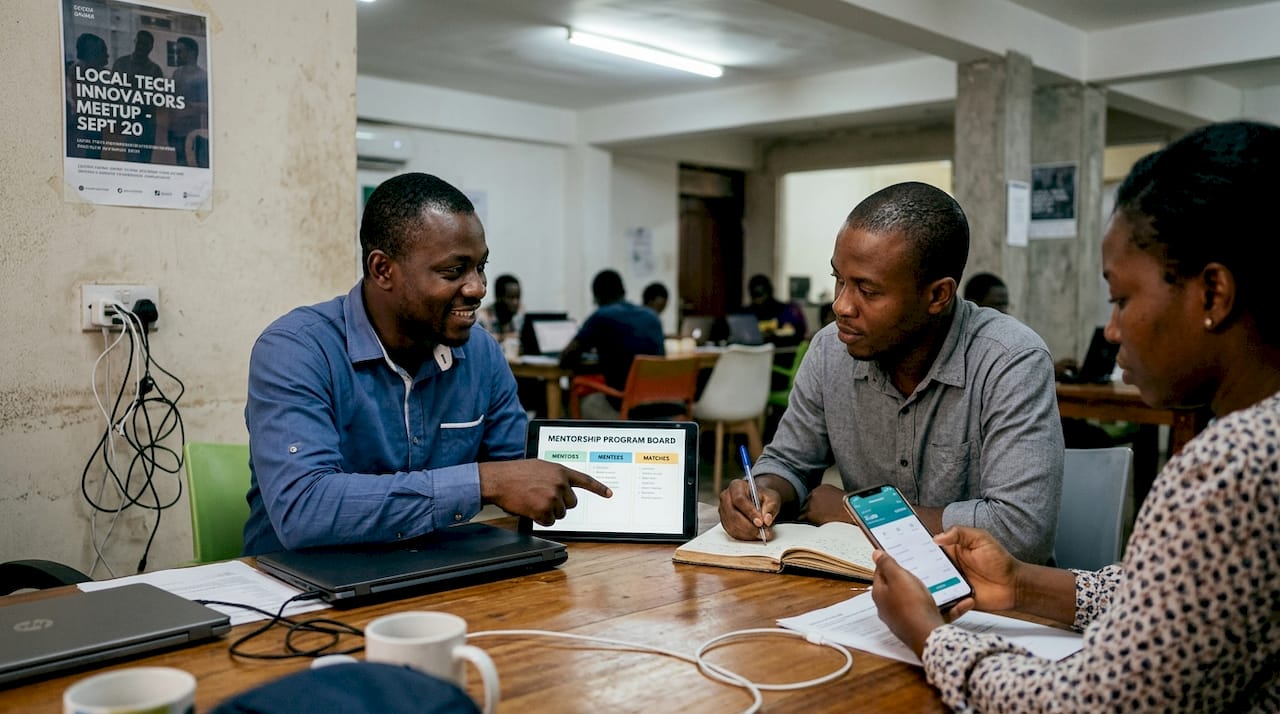
Mentorship is one of the clearest wins. On focused platforms, senior developers and founders can offer structured mentorship to junior professionals, either informally or through paid programs. That kind of relationship rarely forms on open social media, where the signal is too weak and the trust is too thin.
Owllup's 5,000+ user base demonstrates that learning, mentorship, and earning can coexist on a single platform. Members do not have to choose between building their skills and building their income.
The comparison below shows how platform types stack up on key outcomes:
| Outcome | Niche community platform | Open social media |
|---|---|---|
| Mentorship quality | High, structured | Low, informal |
| Monetization options | Fintech, paid content | Ad revenue only |
| Job opportunities | Targeted, vetted | Broad, unfiltered |
| Privacy | Strong | Weak |
| Learning depth | High | Low |
With $3.4 billion in African tech funding flowing in 2026, the stakes for staying connected are higher than ever. Isolation is expensive. Missing a co-founder introduction, a funding lead, or a key hire because you were not in the right community is a real cost.
Here is what active participation in the right platform can deliver:
- Access to vetted co-founders and collaborators across the continent
- Invitations to funding rounds and pitch events through trusted referrals
- Paid mentorship income from sharing technical expertise
- Early access to job postings from startups and tech companies
- Peer accountability groups that accelerate product development
These outcomes compound over time. The career growth available through focused communities is not a one-time event. It builds with every conversation, every collaboration, and every connection. A solid business community platform guide can help you identify which platforms align with your specific goals.
Rethinking the future: What most founders and tech pros get wrong
Here is the assumption worth challenging: bigger communities are better communities. It feels intuitive. More members means more connections, more opportunities, more value. In practice, the opposite is often true.
The most productive professional communities are small, vetted, and private. They are built around shared purpose, not shared geography or shared interests. When everyone in the room is serious, the conversations get serious fast.
DevRel in Africa starts with unpaid community labor, and the professionals who do that work know something important: the depth of a network matters more than its size. Vetted, private networks consistently outperform open ones for serious professional outcomes.
Applied AI tools built for African contexts, not frontier models designed elsewhere, are the next real differentiator. Platforms that invest in moderation technology suited to local languages, local norms, and local connectivity constraints will pull ahead.
The takeaway is simple. Do not chase the biggest community. Chase the most aligned one. Invest in platforms that prioritize active moderation, member vetting, and privacy. That is where the real value lives. Understanding why conversational platforms matter for African entrepreneurs is the first step toward making better choices about where you spend your time and energy.
Take your collaboration further: Try a privacy-first platform
You now have a clear picture of what separates productive professional communities from noisy group chats. The next step is finding a platform that puts those principles into practice.

Discors.chat is a privacy-focused community platform built for founders, developers, and tech professionals who want real conversations without the noise. Post ideas, join discussions, connect with collaborators, and explore opportunities in a moderated, secure environment. Sign up with Google or Apple in seconds. No clutter. No spam. Just focused, real-time discussion with people who are building the same things you are. Join today and start connecting with the African tech community that is actually moving forward.
Frequently asked questions
What makes a community platform better than a typical group chat?
Community platforms offer advanced moderation, structured discussions, and privacy controls that group chats lack, making them ideal for professional networking. Structured boards and filters reduce noise compared to unstructured groups, which is critical at scale.
Are African community platforms safe and private?
Leading platforms use AI-human moderation and closed groups to protect privacy, supporting focused and secure collaboration for tech professionals. Tools like Hive and Two Hat enable scalable hybrid review that keeps communities clean.
How can founders and developers earn or grow their careers on these platforms?
Platforms like Owllup enable mentorship, paid learning, and fintech integrations to monetize knowledge and connect with new opportunities. Owllup integrates mentorship and fintech so members can earn while they build their networks.
What is the biggest challenge with African tech communities?
The biggest challenge is preventing burnout and creating sustainable value while balancing community intimacy and scalable growth. Grassroots communities risk burnout and copycat issues as they grow, which is why structured moderation matters from the start.
What trends shape the future of African tech platforms?
Growth in AI-powered moderation, low-data optimization, and fintech features are defining the next generation of African community platforms. Applied AI for African contexts rather than generic frontier models will be the key differentiator going forward.