
TL;DR:
- AI integration automates tasks, improves content discovery, and enhances community moderation in platforms.
- Tool overload and fragmentation hinder African teams' productivity, requiring better localized, low-bandwidth solutions.
- Localized platforms like Dala succeed by prioritizing safety, language, and connectivity tailored to African users.
Most tech professionals in Africa and the diaspora are juggling five or more tools just to stay connected with their teams. That's not collaboration. That's chaos. AI integration is transforming platforms into agentic systems that automate work at a pace most users haven't prepared for. Meanwhile, fragmented tools, poor safety standards, and platforms built for Western contexts leave African founders and developers at a real disadvantage. This guide breaks down exactly how the next generation of professional discussion platforms is being built, what's working locally, and what you need to know to choose the right space for real collaboration.
Table of Contents
- How AI and autonomous agents are reshaping professional platforms
- The collaboration challenge: Tool overload, fragmentation, and the African reality
- Specialized platforms and local innovation: What's working in Africa and the diaspora
- What future-ready platforms must deliver: Safety, inclusivity, and seamless AI-powered collaboration
- The uncomfortable truth: Why global platforms can't solve Africa's collaboration needs yet
- Take the next step: Find your future-ready discussion platform
- Frequently asked questions
Key Takeaways
| Point | Details |
|---|---|
| AI is transforming platforms | Digital agents automate workflows and change how professionals collaborate online. |
| Local needs drive innovation | African-focused platforms succeed by optimizing for language, bandwidth, and trusted community. |
| Fragmentation blocks productivity | Too many tools and poorly integrated systems waste time and break knowledge flow. |
| Safety and inclusion are critical | Future-ready platforms must prioritize security, vetting, and cultural fit to build trust. |
How AI and autonomous agents are reshaping professional platforms
The shift is already happening. Platforms are no longer just places where people post and reply. They are becoming systems where AI agents handle routine tasks, surface relevant content, and even initiate workflows on your behalf. For tech professionals, this changes everything about how you show up online.
Here is what this shift looks like in practice:
- AI agents can flag relevant job posts, summarize long discussion threads, and route messages to the right people automatically
- Autonomous modules inside platforms can schedule follow-ups, tag collaborators, and track project milestones without manual input
- Professionals spend less time managing notifications and more time on actual strategic work
- New users onboard faster because AI surfaces the most relevant communities and conversations for their profile
The numbers back this up. By 2026, 30% of enterprise vendors offer MCP servers for AI collaboration, and half of ERP vendors are launching autonomous modules. This is not a future trend. It is already the baseline expectation for serious platforms.
For African professionals, this creates both opportunity and pressure. The opportunity is real-time access to tools that used to require large teams. The pressure is that upskilling in AI collaboration habits is no longer optional. You need to know how to work with these agents, not just around them.
The top trends in 2026 show a clear divide between platforms that have integrated AI meaningfully and those that have bolted it on as a feature. The difference shows in user retention, discussion quality, and how fast communities grow.
| Feature | AI-driven platforms | Traditional platforms |
|---|---|---|
| Content discovery | Automated and personalized | Manual browsing |
| Workflow automation | Built-in agent support | None or limited |
| Onboarding speed | Fast, context-aware | Slow, generic |
| Community moderation | AI-assisted and scalable | Human-only, slower |
| Real-time engagement | Proactive and triggered | Reactive only |
Pro Tip: When evaluating a new platform, test whether its AI agent can summarize a thread and suggest your next action. If it can't, you are looking at a traditional tool with an AI label, not a genuinely agentic system. Platforms built around safe collaboration spaces will increasingly use AI to enforce community standards automatically.
The collaboration challenge: Tool overload, fragmentation, and the African reality
With AI on the rise, new features mean little if teams can't work cohesively. Fragmentation is the real enemy of productive collaboration, and it hits African and diaspora tech teams especially hard.
73% of teams struggle with tool fragmentation, and knowledge workers attend 25.5 hours of meetings per week, with only 12% of that time considered productive. Read that again. Twelve percent. The rest is coordination overhead, status updates, and context-switching between apps.
For African tech professionals, the problem compounds quickly:
- Connectivity issues mean async tools often fail at critical moments
- Global platforms default to high-bandwidth video and large file transfers
- Time zone mismatches with diaspora partners create communication gaps
- Security standards on many free tools are inadequate for sensitive business discussions
- Local languages and cultural context are rarely supported
This is why exploring business community platforms built with these realities in mind matters so much. A platform designed for Silicon Valley default conditions will consistently underperform for a founder in Lagos or Nairobi managing a remote team.
| Platform model | Strengths | Weaknesses for Africa |
|---|---|---|
| Global platforms (e.g., Slack, Teams) | Feature-rich, widely adopted | High bandwidth, no local language support |
| Africa-focused platforms | Low-data, local context | Smaller user base, fewer integrations |
| Hybrid community platforms | Moderated, safety-focused | Still maturing in AI features |
The discussion platforms in Africa that are gaining traction are the ones solving for connectivity first, community safety second, and feature depth third. That order matters. A beautiful interface means nothing if the app crashes on a 3G connection.

The bottom line: Tool overload is a productivity tax. Every extra app your team uses costs time in context-switching, login friction, and duplicated communication. Fewer, better-chosen platforms beat a stack of disconnected tools every time.
Specialized platforms and local innovation: What's working in Africa and the diaspora
If fragmentation slows progress, nimble local innovators are already rewriting the playbook. The most effective platforms right now are the ones built specifically for African users and diaspora communities, not adapted from global templates.
Standout platforms gaining real traction include:
- Diaspora Corps: Connects African diaspora professionals with opportunities back home, with vetted community access
- ADEN: Focused on education and professional development with a strong African network
- Breedj: An AI-powered talent marketplace offering tailored tools for networking, mentorship, and talent matching across African markets
- Dala: Built with local languages and low-bandwidth features from day one
Dala's growth is the clearest proof that local-first design works. Dala reached 85,000 users in just four months, with a conversion rate three times the industry average. That result came directly from supporting local languages and optimizing for low-bandwidth environments. It wasn't marketing spend. It was product decisions.
This is the model that works. Build for the actual user, not the assumed user.
Pro Tip: When you join a new platform, look for mentorship features before you look for job boards. The fastest career growth in African tech communities comes from direct access to experienced practitioners, not from passive job listings. Platforms like those listed on top networking platforms for African entrepreneurs are building mentorship pathways directly into their community structures.
If you are evaluating alternatives to existing tools, checking Discussions.Social alternatives gives you a useful comparison of what different platforms prioritize in terms of safety, community design, and feature depth.
The key takeaway from local innovation is this: safety, language, and bandwidth are not edge cases. They are core product requirements for any platform serious about serving African professionals.
What future-ready platforms must deliver: Safety, inclusivity, and seamless AI-powered collaboration
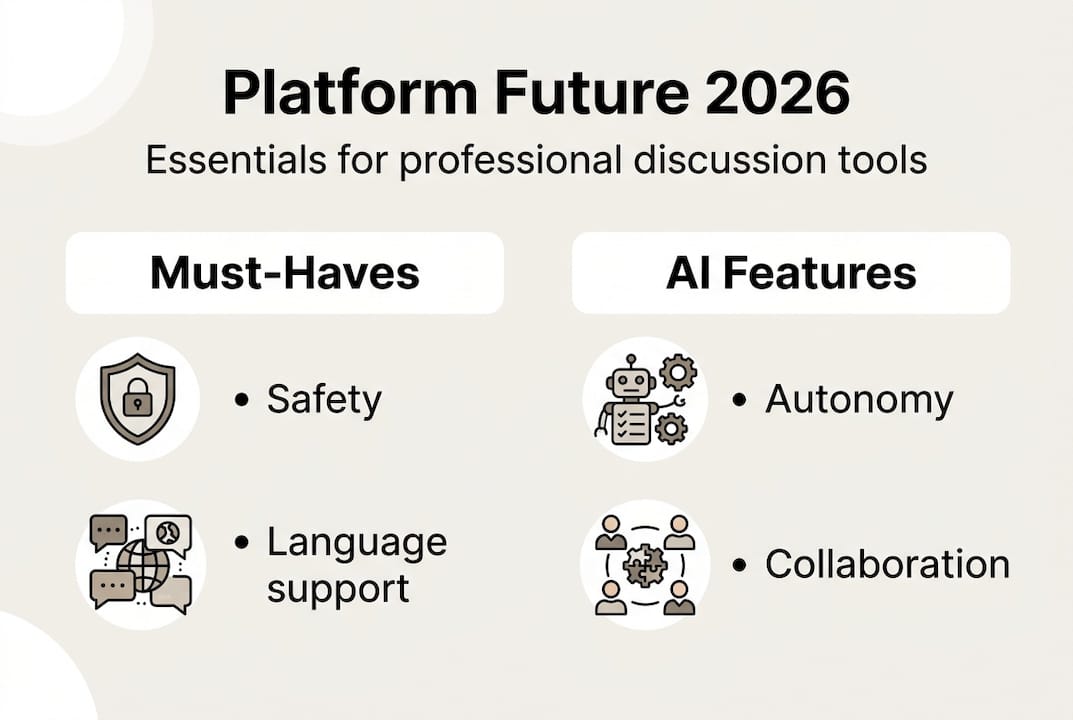
Learning from these local innovations, what will tomorrow's most useful platforms absolutely need? Here's the roadmap.
The HR tech market in Africa is growing at 4.4% annually through 2026 and 2027, driven by AI, compliance needs, and multi-country hiring. Platforms that don't align with these shifts will lose relevance fast.
Here are the non-negotiable features for any future-ready professional platform:
- End-to-end encryption for all private discussions and direct messages
- Local language support covering at least the major African languages and dialects
- Mobile-first design that works on entry-level Android devices, not just flagship phones
- Low-bandwidth optimization so the platform functions on 2G and 3G connections
- Verified community matchmaking to reduce spam and ensure quality connections
- Seamless AI integration that assists without overwhelming or replacing human interaction
"Future platforms must prioritize safety via vetted communities, local language support, and low-data optimization for African and diaspora users. They must integrate AI for real-time engagement while addressing edge cases like poor connectivity."
Global platforms are not designed to solve these problems. They are designed for markets where connectivity, language, and safety are assumed to be solved. For African professionals, those assumptions fail regularly.
If you want to grow your professional community in a meaningful way, the platform you choose needs to reflect your actual operating environment. That means prioritizing moderated discussions where the community standards are enforced and the conversations stay relevant to your goals.
The platforms that will win are not the ones with the most features. They are the ones that make the right features work reliably for their specific users.
The uncomfortable truth: Why global platforms can't solve Africa's collaboration needs yet
Here is what most platform reviews won't tell you. Global tools are not failing African professionals because of bad intentions. They are failing because they were never designed with this audience in mind. SaaS fatigue is real. Professionals are tired of adopting new tools that promise everything and deliver a Western-default experience with an African flag on the homepage.
The real breakthroughs will come from mobile-first, community-trusted, AI-tuned platforms built from the ground up for Africa and its diaspora. Not adapted. Built. That distinction matters more than any feature list.
The conversational platforms for Africa that are gaining ground share one trait: they were designed by people who understand the market from the inside, not from a market research report.
Pro Tip: Always pilot new tools with your actual local user base before committing your team. Adapt the platform to your workflow. Don't reshape your workflow to fit a tool that was never built for you.
Take the next step: Find your future-ready discussion platform
Ready to put these ideas into action?
You now have a clear picture of what separates effective collaboration platforms from the ones that just add noise. The right platform is moderated, mobile-ready, AI-assisted, and built around community safety.

Explore DisCors Chat as a practical next step. Discors.chat is a real-time discussion platform built for founders, developers, and tech professionals who want to connect, share ideas, and find opportunities in a safer space. Sign up with Google or Apple and join conversations that are actually relevant to what you are building. No noise. No clutter. Just focused, real-time discussion with people who are working on the same problems you are.
Frequently asked questions
How do AI agents change professional discussions?
AI agents shift platforms from human-centric to process-centric design, automating routine tasks so professionals can focus on strategic work. This means faster onboarding, smarter content discovery, and less time spent on coordination.
Why do African professionals need specialized discussion platforms?
Specialized platforms offer local language support, vetted communities, and low-data features that global tools don't provide. Platforms like Dala succeed precisely because they are built around these specific needs rather than assuming a high-bandwidth, English-first environment.
How does tool fragmentation affect productivity?
73% of teams struggle with tool fragmentation, leading to wasted time and broken knowledge sharing, especially in hybrid and distributed teams. Fewer, better-integrated tools consistently outperform large disconnected stacks.
Which African-focused platforms are growing fastest?
Dala reached 85,000 users in four months, making it the fastest-growing local platform right now. Its local-first design and community-centric features are the direct reason for that growth rate.