
TL;DR:
- Deep, meaningful conversations build trust and facilitate collaboration in the African tech ecosystem.
- Preparation, platform choice, and applying the TALK method enhance conversation quality.
- Focusing on relational trust and community-led engagement leads to sustainable professional relationships.
Shallow small talk is costing African tech professionals real opportunities. When every conversation stays at the surface, trust never forms, collaboration stalls, and deals fall apart before they begin. The good news is that meaningful discussion is a skill you can build deliberately. Research-backed frameworks like the TALK method, proven talk ratios, and Ubuntu-inspired relational trust give you concrete tools to move past pleasantries and into conversations that actually lead somewhere. This guide covers exactly what to prepare, how to start, and how to sustain discussions that build lasting professional relationships in the African tech ecosystem.
Table of Contents
- What you need to prepare for meaningful discussions
- Step-by-step: Initiating a meaningful discussion
- Maintaining momentum: Keys to engaging and deepening the discussion
- Common mistakes and troubleshooting tips
- A fresh perspective: Why depth and relational trust beat quick wins
- Next steps: Connect on a safe, moderated platform
- Frequently asked questions
Key Takeaways
| Point | Details |
|---|---|
| Prepare thoughtfully | Select relevant topics and moderate platforms that encourage depth and collaboration. |
| Use proven frameworks | Apply the TALK method and optimal talk ratios to initiate and sustain meaningful conversation. |
| Build relational trust | Draw on Ubuntu values and direct engagement to foster authentic, lasting connections. |
| Avoid common pitfalls | Prevent stagnation and ghosting by steering clear of mirror questions and over-dominance. |
| Take action on safe platforms | Move your skills into practice on secure, Africa-focused discussion networks for real results. |
What you need to prepare for meaningful discussions
Preparation is not optional. Walking into a networking conversation without a clear mindset or topic plan is like launching a product without a pitch. You will default to small talk, and small talk rarely leads to collaboration.
Start with the right mindset. Aim for depth over volume. One substantive conversation beats ten shallow exchanges. Approach every interaction with balance, genuine curiosity, and kindness. You are not there to impress. You are there to connect.
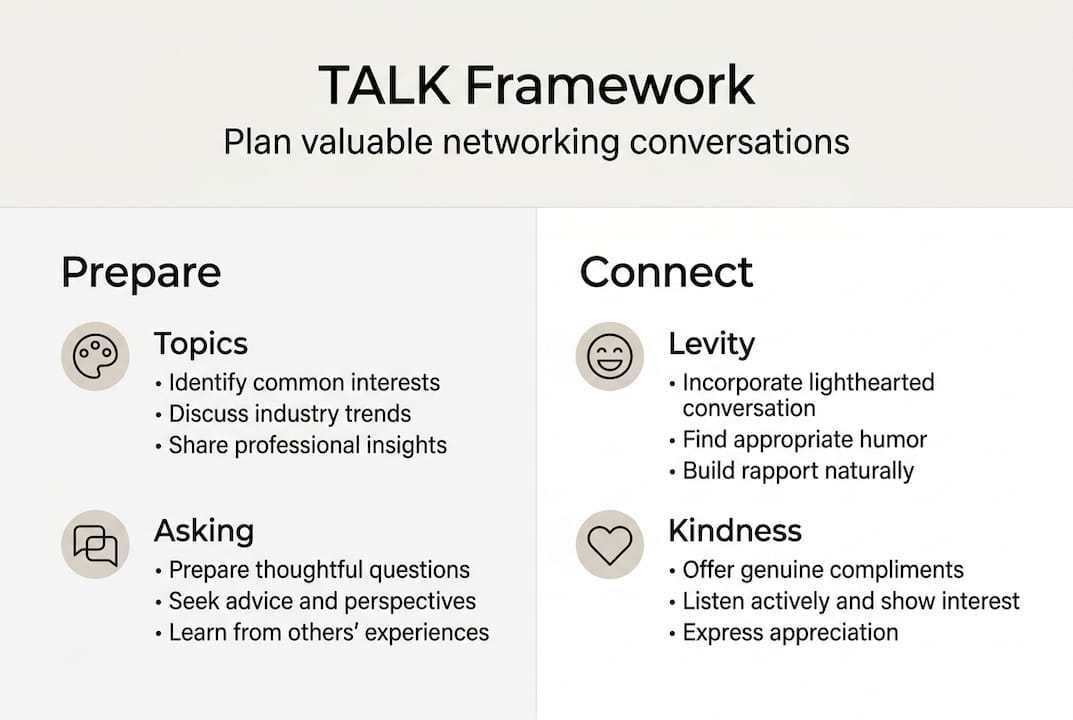
Prepare your topics in advance. Use the TALK framework as your planning tool: Topics, Asking, Levity, and Kindness. Before joining any discussion, write down two or three topics relevant to your audience. Think about the challenges they face, the trends shaping their industry, or the opportunities you see in the African tech space.
Choose the right platform. Platform choice matters more than most people realize. A noisy, unmoderated space kills meaningful conversation before it starts. African tech entrepreneurs can leverage moderated platforms like SANIA, which was built specifically to reduce cross-border fragmentation and support startup collaboration across the continent.
Here is a quick comparison of platforms worth considering:
| Platform | Focus area | Moderation | Collaboration potential |
|---|---|---|---|
| SANIA | African startups | High | Cross-border partnerships |
| Jobtech Alliance | Job tech ecosystem | Moderate | Industry networking |
| Angela Collective | Women in African tech | High | Mentorship and funding |
| TechWings Africa | Pan-African innovation | Moderate | Product and idea sharing |
| Discors.chat | Tech and startup discussions | High | Real-time collaboration |
For a deeper look at how these environments compare, the business community platforms guide breaks down what to look for when selecting a professional space.
Key things to check before joining any platform:
- Community guidelines and moderation policies
- Whether the audience matches your professional goals
- Privacy and data handling practices
- Activity level and response times in discussions
Pro Tip: Always read the community guidelines before posting. Platforms with active moderation reward members who follow the rules with more visibility and better engagement.
If you want a broader view of where African entrepreneurs are networking in 2026, the top networking platforms guide is a useful starting point.
Step-by-step: Initiating a meaningful discussion
With your tools and mindset in place, here is exactly how to start a conversation that matters.
The TALK method was developed by Harvard professor Alison Wood Brooks and has been shown to boost both happiness and the quality of substantive conversations. It gives you a repeatable structure that works whether you are opening a thread on a discussion platform or walking up to someone at a Lagos tech event.
The four TALK steps:
- Topics: Open with a topic that is relevant, timely, and specific to your audience. Generic openers like "What do you do?" rarely lead anywhere interesting. Instead, try something like "I saw the new fintech regulations dropped last week. How is your team thinking about compliance?"
- Asking: Follow up with open-ended questions. Do not stop at one. Follow-up questions increase depth and likability far more than mirror questions, which simply repeat or echo what the other person just said.
- Levity: Keep the tone human. Light humor and empathy signal safety. People open up when they feel comfortable, not interrogated.
- Kindness: End every exchange by acknowledging what the other person shared. A simple "That is a really useful perspective" goes a long way.
Practical initiation steps:
- Choose a moderated platform aligned with your goals
- Read recent discussions to understand the community tone
- Craft an opening message or post with a specific, relevant topic
- Ask one clear, open-ended question to invite response
- Follow up within 24 hours to keep momentum going
Example conversation starters for African tech professionals:
- "What is the biggest barrier you are seeing to scaling a startup across multiple African markets right now?"
- "I am exploring how AI tools are being adapted for local language processing in West Africa. Anyone working on this?"
- "What has surprised you most about building a remote team across different African time zones?"
For more on launching online discussions effectively, there is a practical guide that covers platform-specific tactics.
Pro Tip: Avoid mirror questions at all costs. Repeating what someone just said signals you are not truly listening. Instead, probe one level deeper with a "Why" or "How" follow-up.
Maintaining momentum: Keys to engaging and deepening the discussion
Starting a discussion is only the first step. Here is how to keep it productive and truly meaningful.
One of the most underrated insights in professional communication comes from sales research. The optimal talk ratio for successful business conversations is 43:57, meaning you should be speaking about 43% of the time and listening 57% of the time. Most people do the opposite.
Discovery-first conversations, where you ask before you pitch, close 40% more deals and generate significantly stronger professional relationships than pitch-first approaches.
This holds true in networking, not just sales. When you lead with curiosity instead of credentials, people feel heard. That feeling is the foundation of trust.

Ubuntu-inspired trust building. The African philosophy of Ubuntu, often summarized as "I am because we are," offers a powerful framework for professional interaction. Ubuntu leadership in African contexts fosters psychological safety, collective problem-solving, and relational trust that outlasts any single transaction. When you approach a discussion as a community-building act rather than a personal win, the quality of engagement shifts noticeably.
Here is a quick reference table for maintaining conversation quality:
| Checkpoint | Target | Warning sign |
|---|---|---|
| Talk ratio | 43% speaking, 57% listening | You are talking more than 60% of the time |
| Question type | Mostly follow-up questions | Mostly mirror or yes/no questions |
| Objection handling | Address directly and calmly | Avoiding or deflecting pushback |
| Trust indicators | Reciprocal sharing, follow-ups | One-sided responses, short replies |
Actions to keep conversations going:
- Summarize what you heard before adding your perspective
- Reference something specific the other person said earlier
- Share a relevant resource or insight without expecting anything in return
- Set a clear next step at the end of every meaningful exchange
For more on how moderated discussions drive innovation in African tech communities, and how to moderate discussions effectively in your own community, both guides offer actionable frameworks.
Common mistakes and troubleshooting tips
Even skilled communicators face challenges. These troubleshooting strategies ensure you avoid common pitfalls.
The most common mistake is also the most invisible: dominating the conversation. When your talk ratio climbs above 60%, you are 3.2 times more likely to face ghosting or disengagement after the conversation ends. People remember how you made them feel, not what you said.
Top mistakes to avoid:
- Using mirror questions instead of genuine follow-ups
- Ignoring platform community guidelines
- Pitching before establishing any rapport or trust
- Failing to address objections when they come up
- Treating every conversation as a transaction
- Neglecting cultural context or assuming Western networking norms apply universally
Discovery-first approaches achieve 38% better outcomes than pitch-first strategies in professional networking contexts.
What to do when a conversation stalls:
- Ask a completely different question to reset the direction
- Share something vulnerable or honest about your own experience
- Acknowledge the pause directly: "I want to make sure this is useful for you. What would be most helpful to discuss?"
- If you face ghosting after a good exchange, send one brief follow-up referencing a specific point from the conversation
Pro Tip: Before every discussion, check in on cultural alignment. What counts as directness in one African context may read as aggression in another. Adjust your tone based on the community norms of the platform you are using.
For a broader overview of where these conversations are happening, the discussion platforms overview covers the current landscape for African tech entrepreneurs.
A fresh perspective: Why depth and relational trust beat quick wins
Stepping back, the conventional Western networking playbook is built around speed and transactions. Get in, make your pitch, collect a contact, move on. That model works in environments where trust is assumed. In the African tech ecosystem, trust is earned through relationship, not assumed through proximity.
Ubuntu leadership research shows that communities built on relational trust are more resilient, more collaborative, and more innovative over time. The "I am because we are" principle is not just a cultural saying. It is a competitive advantage.
"I am because we are" is not just philosophy. It is a framework for building the kind of professional network that actually shows up when things get hard.
Safe, moderated platforms reduce the fragmentation that kills good conversations before they start. When you know a space is curated and protected, you take more risks in dialogue. You share more. You ask harder questions. That is where real collaboration begins.
Pro Tip: Approach every discussion as a chance to build community, not just close a deal. The professionals who do this consistently are the ones who get introduced to the right people without ever having to ask.
For more on why joining professional platforms for growth matters beyond just visibility, that guide covers the long-term case for intentional community participation.
Next steps: Connect on a safe, moderated platform
Ready to take your conversation skills and networking to the next level? Here is where to start.
All the frameworks in this guide work best when you practice them in a space designed for real dialogue. Discors.chat is built for exactly that. It is a moderated, real-time discussion platform where African tech professionals, founders, and developers can post, comment, follow trending topics, and connect without the noise of traditional social media.

You can start networking safely on Discors today by signing up with Google or Apple in seconds. Apply the TALK method, maintain your talk ratio, and build the kind of community-first connections that last. If you want to explore more options first, the guide to discover leading platforms gives you a full comparison to make the right choice for your goals.
Frequently asked questions
What makes a discussion meaningful in a professional context?
A meaningful discussion involves deep, relevant topics, active listening, and genuine follow-up questions that build trust and lead to collaboration. The TALK method provides a repeatable structure for achieving this consistently.
How can African professionals find moderated platforms for networking?
Africa-focused platforms like SANIA, Jobtech Alliance, and TechWings Africa offer moderated, secure environments specifically designed for tech collaboration and cross-border networking.
What talk ratio is optimal for business networking?
A 43:57 speaker-to-listener ratio is most effective, meaning you should spend more time asking questions and listening than speaking.
How does Ubuntu philosophy help with discussions?
Ubuntu fosters community-based trust and psychological safety, making conversations more collaborative and producing stronger, longer-lasting professional relationships.
What are some mistakes to avoid in networking discussions?
Avoid mirror questions, dominating the talk, neglecting community rules, and pitching before building rapport. Follow-up questions consistently outperform mirror questions for depth and connection.