
TL;DR:
- Africa's tech communities benefit from small, focused, and well-moderated discussion groups.
- Choosing platforms like Slack or Discord depends on community tone, device, and data considerations.
- Layered moderation, personalization, and safety measures are essential for active, secure engagement.
Africa's tech scene is growing fast. Developers, founders, and innovators are building real things, but too many miss out on the connections that move careers and companies forward. Unsafe platforms, high data costs, and noisy feeds push valuable voices to the sidelines. This guide walks you through choosing the right platform, setting up a safe discussion space, moderating effectively, and keeping your community active. Whether you want to network, collaborate, or share ideas, the steps here give you a clear path to making real-time discussions work for you.
Table of Contents
- Understanding the need for real-time discussions in African tech communities
- Choosing the right platform: Slack vs Discord and beyond
- Setting up your real-time discussion space for safety and engagement
- Maintaining healthy discussions: moderation, retention, and growth
- A new perspective: Why small, well-moderated groups are Africa's innovation engine
- Launch your real-time community with Discors.Chat
- Frequently asked questions
Key Takeaways
| Point | Details |
|---|---|
| Tailor platform choice | Select Slack or Discord based on your community’s needs, prioritizing mobile and moderation features. |
| Prioritize safety | Set up layered moderation and trust systems to protect users from scams and harassment. |
| Boost engagement | Use personalization and smaller, well-moderated spaces to drive deeper collaboration and retention. |
| Leverage data-light modes | Favor platforms with data-light features to maximize accessibility for African tech communities. |
Understanding the need for real-time discussions in African tech communities
Real-time discussions are not just a convenience. For African tech communities, they are a direct line to knowledge, opportunity, and collaboration. When a developer in Lagos can ask a question and get an answer from a founder in Nairobi within seconds, that is the kind of exchange that builds ecosystems. But the current state of most platforms makes this harder than it should be.
Three major barriers slow things down. First, scams and harassment block roughly 50% of potential participants from engaging fully. Second, high data costs affect about 70% of mobile users across the continent, making data-heavy platforms impractical. Third, participation is unequal by design. Research shows participation inequality persists across social platforms, where just 1% of users create 37% of all content. The rest watch from the sidelines.
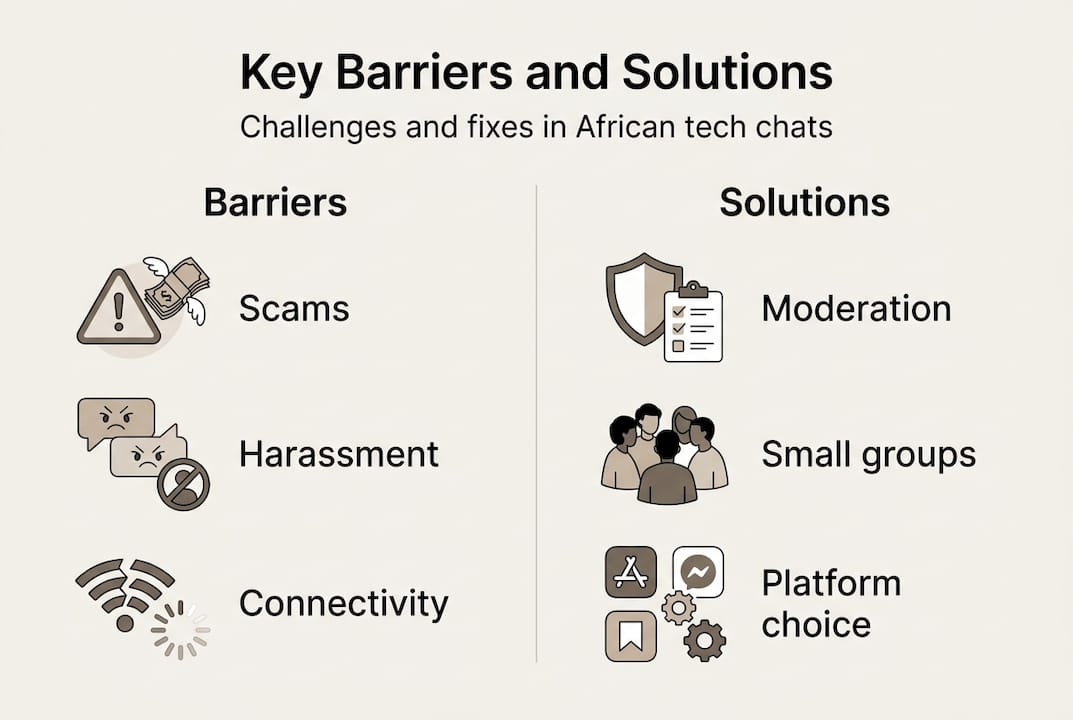
These barriers matter because they silence the people who have the most to contribute. A junior developer with a sharp idea stays quiet if the platform feels unsafe or eats through their data plan.
The good news is that smaller, niche communities perform better. Smaller communities show engagement rates of 4.2% compared to just 1.5% on larger platforms. Focused groups create trust faster, encourage more voices, and lead to more actionable outcomes. Personalization also plays a major role. Apps that use personalized prompts and content targeting see day-two retention jump from 18% to between 38% and 40%.
For African tech professionals, conversational platforms in Africa that are built with these realities in mind are not optional extras. They are the foundation for meaningful networking.
Here is what effective real-time discussion platforms must offer for African tech communities:
- Mobile-first design with low data consumption
- Moderation tools that filter scams and harassment
- Focused topic channels to reduce noise
- Reputation systems that reward consistent contributors
- Options for paid or gated communities to improve safety
If you are exploring your options, joining tech discussion platforms that check these boxes is the first step toward building real professional momentum.
Choosing the right platform: Slack vs Discord and beyond
Not every platform fits every community. Your choice should match your goals, your audience's devices, and the kind of conversations you want to host. Two platforms dominate the space: Slack and Discord. Both have strengths, but they serve different purposes.
Slack suits professional tech networking and structured knowledge sharing. It works well for teams, startup communities, and groups that need organized channels, integrations with tools like Notion or GitHub, and a clean, professional interface. Discord, on the other hand, is built for energy and interaction. It supports voice and video natively, encourages casual conversation, and has a strong culture of active participation. Discord fits vibrant collaboration where founders and developers want to connect in real time with less formality.

Here is a quick comparison to help you decide:
| Feature | Slack | Discord | Africa-specific notes |
|---|---|---|---|
| Mobile experience | Good | Excellent | Both work on Android; Discord is lighter |
| Data usage | Moderate | Low to moderate | Test on your network before committing |
| Moderation tools | Strong | Very strong | Discord has more granular controls |
| Voice and video | Limited (paid) | Built-in and free | Discord wins for live collaboration |
| Paid communities | Yes (Slack Connect) | Yes (Server Boosts) | Paid tiers reduce spam significantly |
| Best use case | Professional networking | Casual, high-energy groups | Choose based on your community tone |
Beyond Slack and Discord, look at platforms built specifically for discussion platforms for entrepreneurs in emerging markets. These often prioritize data-light modes and localized moderation.
Pro Tip: Before launching, run a 7-day test with 10 to 20 trusted members. Ask them to rate the platform on data use, ease of access, and safety. Their feedback will tell you more than any feature list.
Key factors to evaluate before choosing:
- Does it work well on a 3G connection?
- Can you assign moderators without paying for premium tiers?
- Does it support topic-based channels or threads?
- Are there tools to verify users or flag suspicious accounts?
Staying current on top trends for discussion platforms will also help you make a future-proof choice as the space evolves quickly.
Setting up your real-time discussion space for safety and engagement
A well-set-up space does not happen by accident. It requires clear rules, the right tools, and a moderation system that works before the first post goes live. Here is a step-by-step process:
- Create your group or server. Choose your platform, name your space clearly, and write a short description that tells people exactly who it is for.
- Set community rules. Post them in a pinned channel. Keep rules simple: no spam, no harassment, stay on topic, report suspicious behavior.
- Assign trusted moderators. Start with two to three people who understand your community's values. Rotate duties to prevent burnout.
- Enable AI toxicity filters. Both Slack and Discord support third-party bots that flag harmful content automatically.
- Create onboarding prompts. Ask new members to introduce themselves. This single step increases early engagement significantly.
- Set up reporting tools. Make it easy for users to flag scams, harassment, or off-topic content.
Moderation is where most communities fail. Research on edge cases in real-time discussions shows that bad actors use evasion techniques like deliberate misspellings, context-dependent toxicity, and coordinated fake support attacks (called fanchuan) to bypass basic filters. Age verification gaps and stock talk manipulation are also common. The solution is layered: use AI for volume, humans for nuance.
"Automation scales volume, humans handle nuance." Balancing volume and nuance is the core principle behind effective community moderation.
Pro Tip: Build a user reputation score from day one. Members who consistently post quality content earn higher trust levels. This discourages low-effort or harmful behavior naturally.
Here is a simple framework for your moderation setup:
| Moderation layer | Tool type | Purpose |
|---|---|---|
| AI filter | Bot or plugin | Catches spam and toxic language at scale |
| Human review queue | Moderator dashboard | Handles context-dependent or edge-case content |
| User reputation system | Platform feature | Rewards quality contributors |
| Reporting flow | In-app button | Empowers users to flag issues quickly |
For more detailed guidance, the resource on moderating thriving communities covers advanced setups. If you are starting from scratch, launching online discussions gives you a practical first-step framework.
Maintaining healthy discussions: moderation, retention, and growth
Setting up is the easy part. Keeping a community active, safe, and growing over months takes consistent effort and smart systems.
Retention starts with personalization. Personalized engagement in mobile-first apps pushes day-two retention from 18% to nearly 40%. That means sending targeted prompts, recommending relevant threads, and surfacing content that matches each member's interests. Most platforms support this through notification settings and channel subscriptions.
Growth comes from recognition. Spotlight contributors publicly. Create a weekly highlight of the best posts or most helpful members. Offer mentorship channels where experienced founders answer questions from newer developers. These small actions build loyalty fast.
For safety, paid communities and trust-first frameworks reduce scam and harassment rates significantly. A small entry fee or application process filters out bad actors before they join.
Here are the most effective retention and growth tactics:
- Rotate moderation duties monthly to keep standards fresh
- Use reputation scoring to identify and reward top contributors
- Run weekly or bi-weekly themed discussions to drive consistent participation
- Create a dedicated channel for job postings, product launches, and collaboration requests
- Offer exclusive content or early access to events for active members
- Track engagement metrics monthly and adjust your content strategy based on what works
Pro Tip: Smaller sub-groups within your main community drive the deepest engagement. Create focused channels for specific topics like fundraising, product design, or developer tools. Members who find their niche stay longer.
For ongoing guidance, the resources on moderated networking in Africa and starting tech discussions offer practical frameworks you can apply immediately.
A new perspective: Why small, well-moderated groups are Africa's innovation engine
Here is something most platform guides will not tell you. Bigger is not better. The instinct to grow your community as fast as possible often destroys the very thing that makes it valuable.
Large platforms create broad but shallow participation. A few voices dominate, most members lurk, and the signal-to-noise ratio drops fast. Small, curated groups do the opposite. They create the conditions for real trust, honest feedback, and the kind of idea exchange that actually leads somewhere.
Smaller niche communities sustain deeper engagement compared to larger platforms where participation is wide but thin. Automation can scale content volume, but humans handle the nuance that keeps conversations meaningful.
For Africa's mobile-centric tech ecosystem, this matters even more. Data costs make casual browsing expensive. Members who join a focused, well-moderated group are there with intent. They are not scrolling. They are participating.
The communities producing the most innovation are not the biggest ones. They are the ones where every member feels heard, where moderators catch problems early, and where the focus stays tight. If you want to build something that lasts, invest in depth over scale. Explore what networking innovation in Africa looks like when trust is the foundation.
Launch your real-time community with Discors.Chat
You now have a clear picture of what it takes to run effective, safe real-time discussions. The next step is finding a platform built for exactly this.

Discors.Chat is designed for African tech founders, developers, and innovators who want to connect without the noise. It combines moderated discussions, real-time chat, and community tools in one mobile-friendly space. You can join existing conversations or start your own. Sign up with Google or Apple in seconds. If you want to see what the right platform looks like in practice, explore African tech platform options and find the space where your next collaboration begins.
Frequently asked questions
Which platform is best for real-time tech discussions in Africa?
Slack and Discord are both strong choices. Slack fits professional, structured conversations while Discord works better for casual, lively collaboration. Choose based on your community's tone and your members' mobile and data needs.
How can safety be ensured in real-time discussions?
Safety requires layered moderation: AI filters for toxicity at scale, human review for edge cases and evasion techniques, user reputation systems, and data-light modes that keep all members able to participate.
What boosts discussion platform retention in Africa?
Personalization and smaller groups are the biggest drivers. Targeted prompts, relevant content recommendations, and data-light features push retention rates from 18% up to nearly 40% for African tech communities.
How do you avoid scams or harassment?
Use paid or gated communities, active moderation, and trust-first frameworks. A small entry barrier filters out bad actors, and consistent moderation keeps the environment safe for genuine participants.