
TL;DR:
- % of users report experiencing bullying in unmoderated online spaces impacting African tech communities. Safe platforms foster trust, participation, and faster innovation through hybrid moderation and inclusive leadership. Unsafe spaces cause mental health issues, decrease engagement, and hinder technological progress.
41% of adults report experiencing bullying in unmoderated online spaces. For tech professionals and entrepreneurs across Africa, that number is not just a statistic. It is a daily reality that shapes how freely people share ideas, seek feedback, and build networks. Unsafe platforms push talented voices out of conversations that matter. This guide breaks down why safety is foundational to tech innovation, what happens when platforms fail their users, and what you can do to build or find spaces where real collaboration thrives.
Table of Contents
- Why safety matters for tech discussions in Africa
- The consequences of unsafe online spaces
- Best practices for moderation: Balancing technology and human nuance
- Frameworks for fostering safe and inclusive online discussions
- A fresh take: What most guides miss about safe tech discussions
- Discover a safer platform for your next tech discussion
- Frequently asked questions
Key Takeaways
| Point | Details |
|---|---|
| Psychological safety drives innovation | Safe communities enable risk-taking, feedback, and sustained participation crucial for tech progress. |
| Moderation prevents harm | Hybrid human-AI moderation reduces bullying, protects mental health, and ensures platform longevity. |
| Balance is essential | Over-moderation risks self-censorship, under-moderation causes toxicity; the right frameworks solve this challenge. |
| Local context matters | Moderator training and language-specific policies are critical for African tech platforms to avoid bias and foster trust. |
| Frameworks enable safer discussions | Clear guidelines, trauma-informed design, and collective identity-building foster inclusive and healthy online collaborations. |
Why safety matters for tech discussions in Africa
Safety in online communities is not just about blocking bad actors. It is about creating the conditions where people feel confident enough to take risks, ask questions, and share unfinished ideas. That is the core of psychological safety, which researchers define as a shared belief that a group is safe for interpersonal risk-taking.
Psychological safety in online communities enables risk-taking, feedback-seeking, and sustained participation that is critical for tech collaboration. When developers and founders feel safe, they share code early, ask for critique, and iterate faster. When they do not, they stay quiet. That silence is expensive.
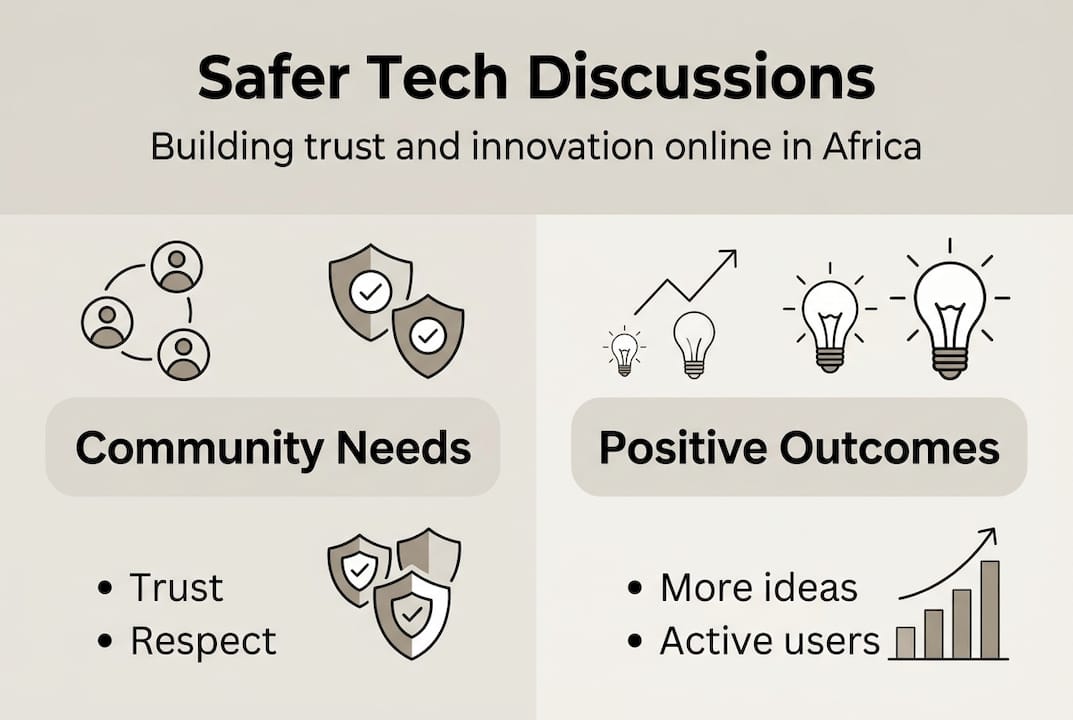
For African tech professionals, this matters even more. Many operate in ecosystems where trust is still being built across borders, languages, and industries. Networking in online communities becomes far more productive when participants trust the space they are in. Psychological safety is the foundation that makes that trust possible.
Here is what the research connects:
| Factor | Low psychological safety | High psychological safety |
|---|---|---|
| Participation rate | Drops sharply | Sustained and active |
| Code quality feedback | Avoided | Sought and welcomed |
| Innovation output | Stalled | Accelerated |
| Community retention | Low | High |
The data is clear. Platforms that invest in safety do not just protect users. They actively improve the quality of work that happens on them.
For platforms serving African tech entrepreneurs, this means designing for trust from day one. That includes moderation policies, clear community norms, and spaces where diverse voices are heard without fear of ridicule or harassment.
"A community that feels safe is a community that builds together. Without that foundation, collaboration is just performance."
Key benefits of psychologically safe tech communities include:
- Faster feedback loops on products and ideas
- Higher quality contributions from more participants
- Stronger collective identity across distributed teams
- Better retention of experienced contributors
The consequences of unsafe online spaces
Unsafe platforms do real damage. The harm is not abstract. It shows up in burnout, mental health crises, and users leaving platforms entirely.
For African tech workers, the stakes are especially high. Mental health issues from unsafe spaces include PTSD from repeated exposure to unmoderated toxic content, particularly for those working in content moderation roles. These workers often face low pay, minimal psychological support, and constant exposure to graphic or abusive material.

41% of users report experiencing bullying in unmoderated spaces. That figure comes from empirical research tracking user behavior across online communities. When users feel unsafe, they leave. And when the most active contributors leave, the platform loses its value for everyone.
The consequences stack up fast:
- Anxiety and depression increase among regular users exposed to hostile interactions
- Burnout hits moderators who lack trauma-informed support structures
- PTSD develops in workers repeatedly exposed to violent or abusive content
- Engagement drops as users self-censor or disengage entirely
- Retention collapses as trusted contributors migrate to safer alternatives
- Innovation slows because risk-taking requires psychological safety
The African tech platform challenges around moderation are compounded by limited resources, linguistic diversity, and inconsistent enforcement. Platforms that ignore these realities do not just lose users. They actively harm the people trying to build something meaningful on them.
The tech worker community in Africa is pushing for better standards. But change starts with platform design and policy, not just advocacy.
Pro Tip: Watch for early signs of moderator fatigue. Rotating moderation duties, offering mental health resources, and setting clear limits on exposure to harmful content are practical steps any platform can take right now.
Best practices for moderation: Balancing technology and human nuance
No single tool solves moderation. AI systems are fast and scalable. They catch spam, flag keywords, and process thousands of posts per minute. But they miss context. A phrase that is offensive in one language may be neutral in another. Cultural references, slang, and regional dialects all create edge cases that algorithms cannot reliably handle.
Hybrid moderation methodologies are now considered best practice. AI handles volume and speed. Human moderators handle nuance, edge cases, and culturally specific content. Together, they reduce bias and improve outcomes for diverse communities.
Here is how the three main approaches compare:
| Moderation type | Strengths | Weaknesses |
|---|---|---|
| AI only | Fast, scalable, consistent | Misses cultural context, prone to bias |
| Human only | Nuanced, context-aware | Slow, expensive, prone to burnout |
| Hybrid | Balanced, adaptive | Requires investment and coordination |
For African tech communities, the hybrid model is not optional. It is essential. Languages like Kiswahili, Yoruba, Amharic, and Zulu are low-resource languages that AI systems consistently mishandle. Native speakers must be part of the moderation team.
Best practices for effective moderation include:
- Recruit local moderators who speak the community's primary languages
- Build adaptive workflows that escalate complex cases to senior human reviewers
- Apply trauma-informed policies that protect moderator mental health
- Audit AI decisions regularly to catch and correct systematic bias
- Create clear appeals processes so users trust the system is fair
Explore moderation best practices and discussion platform trends to stay current on what works.
Pro Tip: Continuous moderator training is not a one-time event. Schedule monthly reviews of flagged content, update guidelines as community language evolves, and make local language support a non-negotiable hiring criterion.
Frameworks for fostering safe and inclusive online discussions
Moderation tools are only part of the solution. The other part is intentional community design. How a platform is structured, led, and governed shapes the culture far more than any single policy.
Leadership style matters. Over-moderation pushes people toward self-censorship. Users stop sharing real opinions because they fear removal. Under-moderation lets toxicity spread until good-faith participants leave. The goal is balance, and that balance requires active, inclusive leadership.
Safe platforms foster collective identity, trust, and meaningful networking for online communities of practice and entrepreneur groups. That identity does not emerge automatically. It is built through clear norms, consistent enforcement, and leaders who model the behavior they expect.
Practical framework pillars for African tech communities:
- Clarity of norms: Post community guidelines prominently. Make expectations specific, not vague.
- Inclusive leadership: Ensure moderators reflect the diversity of the community they serve.
- Trauma-informed design: Build reporting tools that are easy to use and responses that are fast and respectful.
- Collective identity: Create rituals, recognition systems, and shared goals that reinforce belonging.
Moderated networking strategies and guidance on launching discussions for African pros offer more detail on putting these pillars into practice.
For founders and developers, the Africa's AI gig economy context adds urgency. Workers in this space need platforms that protect them, not just engage them.
"Inclusive leadership is not about removing all conflict. It is about creating the conditions where conflict leads to better ideas instead of broken communities."
A fresh take: What most guides miss about safe tech discussions
Most moderation guides focus on tools and policies. Few talk about the humans running those tools or the cultural assumptions baked into those policies.
Here is what gets left out. Moderator mental health is a systemic issue, not an individual one. Platforms that treat burnout as a personal problem rather than a design failure will keep losing good moderators. Expert nuance on moderation confirms that AI-human partnership works best when continuous training and context-aware decisions are built into the workflow, not added as afterthoughts.
Cultural context is not a feature. It is a requirement. An algorithm trained on English-language data will fail Swahili speakers. A moderation policy written without local input will miss what actually harms people in that community.
Over-moderation is a real risk. When platforms crack down too hard, they silence the exact voices they claim to protect. Under-moderation lets toxicity define the culture. Nuanced leadership, informed by local realities, is the only path through.
Africa needs platforms that are built with linguistic diversity, union-backed moderator protections, and trauma-informed design at the core. Not as add-ons. As foundations. Moderation and innovation strategies that center these realities will outlast those that do not.
Pro Tip: Build your platform's moderation philosophy around local realities first. Then layer in technology. Not the other way around.
Discover a safer platform for your next tech discussion
You have seen the evidence. Unsafe platforms cost you participation, trust, and innovation. The right space changes what is possible.

Discors is a moderated discussion platform built for founders, developers, and tech professionals who want real conversations without the noise. It combines real-time discussion, community building, and content discovery in one space that prioritizes safety and meaningful interaction. Whether you are looking for collaborators, sharing a project, or exploring trending topics in African tech, Discors gives you the structure to do it well. Start a discussion today and connect with a community that is built to support what you are building.
Frequently asked questions
What makes an online discussion platform safe for tech professionals in Africa?
A safe platform combines hybrid moderation, clear norms, trauma-informed policies, and local language support to prevent bias and protect mental health. These elements work together to create an environment where users feel secure enough to participate fully.
What are the most common risks on unmoderated discussion platforms?
Users face bullying, harassment, anxiety, depression, and potential PTSD, often leading to user exodus and platform abandonment. 41% bullying reports in unmoderated spaces confirm how quickly toxicity drives people away.
How can moderation address linguistic diversity on African tech platforms?
Moderation must include native speakers and local context experts, aided by AI tools but guided by human decisions to avoid bias. Low-resource African languages suffer inconsistent moderation when AI systems lack proper training data for those languages.
What actions can African tech entrepreneurs take to foster safer discussions?
They can establish clear moderation guidelines, promote trauma-informed practices, and build collective identity through inclusive leadership. Safe platforms foster identity and trust that directly supports better networking and collaboration outcomes.
Are hybrid moderation systems effective for African online communities?
Yes, hybrid systems scale well and adapt to local realities, but require regular training and context-aware policy updates to remain effective over time.