
Social media giants still grab the headlines, but the real action for tech entrepreneurs is happening somewhere else entirely. Dedicated discussion platforms are staging a powerful comeback, and this time they're arriving with AI moderation, decentralized architecture, and collaboration tools that put community owners firmly in control. The resurgence of forums and hybrid platforms signals a fundamental shift: professionals want structured, high-value conversations, not endless scroll. This guide breaks down every major trend, platform type, and strategy you need to build a thriving community in 2026.
Table of Contents
- Why discussion platforms are thriving in 2026
- The evolution: Forums, hybrids, and the Fediverse
- Ensuring safety: The new frontier of AI-powered moderation
- Collaboration and productivity: How platforms enable meaningful work
- Building your ideal community: Practical strategies for 2026
- Take your next step with Discors
- Frequently asked questions
Key Takeaways
| Point | Details |
|---|---|
| Forum resurgence | Modern forums and hybrid models are driving deep, structured online conversations. |
| AI moderation standards | Cutting-edge AI and hybrid approaches are making communities much safer and more engaging. |
| Decentralization advantages | Decentralized, self-hosted platforms provide unmatched ownership but have higher technical overhead. |
| Productivity features leap | Unified collaboration tools, async media, and AI summaries raise productivity for teams and entrepreneurs. |
| Retention driven by engagement | Communities with smart onboarding and AI engagement see the highest member loyalty and activity. |
Why discussion platforms are thriving in 2026
For years, the assumption was simple: if you want community, go to Facebook Groups, LinkedIn, or Twitter. That assumption is cracking. Founders and developers are discovering that algorithm-driven feeds bury the conversations that actually matter, and that handing your community data to a third party creates real business risk.
The shift is structural. Forum structure supports deep networking in ways that social feeds simply cannot replicate. Threaded discussions, searchable archives, and topic-specific channels create a knowledge base that compounds in value over time. A tweet disappears in hours; a well-structured forum thread stays discoverable for years.
"The return of forums and hybrid platforms is driven by a need for structure, data ownership, and sustainable monetization that mainstream social media cannot provide." — Thrico Community Research
Several forces are accelerating this trend right now:
- Privacy and data ownership: Community operators want to own their member data, not rent access to it.
- Monetization control: Platforms like Circle and Mighty Networks let you charge for access without splitting revenue with a social giant.
- Signal over noise: Niche forums attract higher-intent members, making every conversation more valuable for top platforms for entrepreneurs.
- Career and network value: Professionals increasingly use focused communities for career growth via discussion platforms rather than broadcasting into a void.
- Authenticity demand: Social media users are pushing back against curated perfection and craving real, unfiltered dialogue.
The result is a market where purpose-built discussion platforms are winning the attention of exactly the people you want in your community: engaged, motivated, and ready to contribute.
The evolution: Forums, hybrids, and the Fediverse
Not all discussion platforms are built the same, and choosing the wrong type can cost you months of rebuilding. The landscape now breaks into three distinct categories, each with a different value proposition.
Classic forums like Discourse and phpBB offer proven, searchable thread structures. They're excellent for technical communities and open-source projects where deep archives matter. The tradeoff is that setup and maintenance require more technical investment.
Hybrid SaaS platforms like Circle and Mighty Networks combine forum-style threads with live events, courses, and membership billing. They're faster to launch and require minimal technical skill, but you're subject to their pricing changes and terms of service.
Decentralized options like Lemmy and Mastodon operate on the Fediverse, a network of independently run servers that can communicate with each other. Hybrid and decentralized platforms offer different control and engagement benefits depending on your priorities. Decentralized tools give you maximum ownership but demand real admin expertise.

| Platform type | Data control | Engagement tools | Cost | Technical complexity |
|---|---|---|---|---|
| Classic forum (Discourse) | High | Moderate | Low to medium | Medium |
| Hybrid SaaS (Circle, Mighty) | Medium | High | Medium to high | Low |
| Decentralized (Lemmy, Mastodon) | Very high | Moderate | Low (self-hosted) | High |
| White-label custom | Very high | Customizable | High upfront | High |
The white-label platform trends show a clear move toward self-hosted and branded environments, especially for businesses that plan to monetize their community long-term. If you're exploring forum and hybrid alternatives or launching specialized discussions for a niche audience, the platform type you choose will define your ceiling.
Pro Tip: If you're pre-product-market-fit, start with a SaaS hybrid to move fast. Once your community hits 500 active members, evaluate whether migrating to a self-hosted or white-label solution makes financial and strategic sense.
Ensuring safety: The new frontier of AI-powered moderation
A thriving community is only as good as the trust its members feel. In 2026, safety is not a feature you bolt on after launch. It's a core infrastructure decision that shapes whether people stay, contribute, and invite others.
AI-driven, multimodal moderation now combines text analysis, image recognition, and behavioral pattern detection to catch abuse before it escalates. The days of relying solely on volunteer moderators are over for any community that wants to scale.
Here's how effective moderation flows in three stages:
- Automated pre-screening: AI scans every post and comment in real time, flagging content that matches known patterns of harassment, spam, or harmful language. This happens before the content is visible to the broader community.
- Human review queue: Flagged content goes to a moderation dashboard where trained reviewers make final calls on edge cases. This keeps false positives from silencing legitimate voices.
- Feedback loop and rule refinement: Every human decision trains the AI model, improving accuracy over time. Communities that invest in this loop see dramatically fewer repeat violations.
The impact is measurable. Platforms using context-aware AI moderation report significant reductions in toxic content and faster response times compared to manual-only approaches. This directly supports moderation for thriving communities at scale without burning out your team.
Pro Tip: Most community leaders set up basic keyword filters and call it done. The real edge comes from monitoring behavioral patterns, such as users who never post but mass-report others, or accounts that spike in activity right after a new member joins. These edge cases are where harassment often hides.
Collaboration and productivity: How platforms enable meaningful work
Discussion platforms in 2026 are not just places to talk. They're becoming the operating layer for distributed teams and professional communities. The feature sets have matured dramatically, and the productivity gains are real.
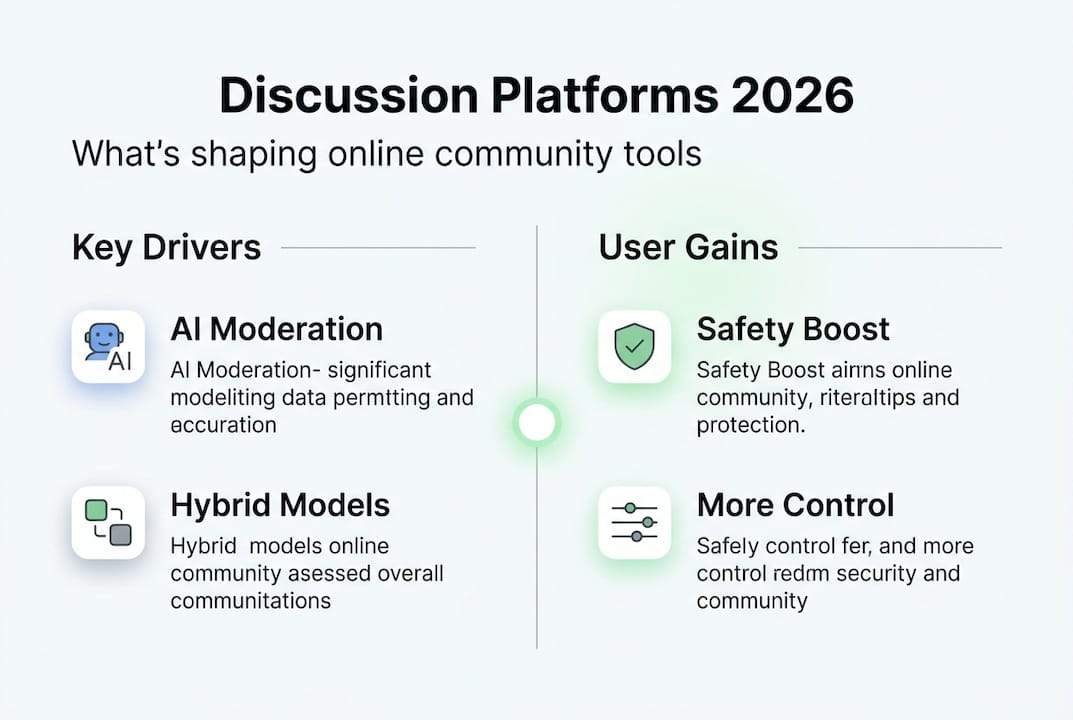
Unified platforms deliver 25% higher productivity by reducing the context-switching that kills deep work. When your team's async updates, project discussions, and knowledge base all live in one place, you stop losing hours to hunting through Slack threads and email chains.
The features driving this shift include:
- Async video and voice messages: Members record quick updates without scheduling a meeting, which is critical for teams across time zones.
- AI summarization: Long threads get condensed into action items automatically, so late joiners catch up in seconds instead of minutes.
- Smart scheduling and event tools: Built-in calendars and RSVP features keep community events visible without requiring a separate tool.
- Searchable knowledge archives: Every discussion becomes a searchable resource, turning community conversations into institutional knowledge.
| Feature | Productivity gain | Engagement impact |
|---|---|---|
| AI thread summarization | Saves 40% reading time | Higher participation from busy members |
| Async video updates | Reduces meetings by 30% | Stronger personal connection |
| Smart onboarding flows | Cuts setup time by 50% | Lower early churn |
| Integrated event scheduling | Saves 2+ hours per event | Higher attendance rates |
For entrepreneurs, the top use cases are clear. Whether you're using a platform for product launch discussions or tracking trending topics for business growth, these features turn a passive community into an active business asset.
Building your ideal community: Practical strategies for 2026
Knowing the trends is one thing. Executing on them is another. Here's a concrete framework for building a community that grows, retains members, and delivers real value.
- Clarify your community's core purpose: Before picking a platform, write one sentence that defines who the community serves and what specific outcome it delivers. Vague communities attract vague members.
- Select your platform based on growth stage: Early-stage communities benefit from SaaS speed; mature communities benefit from ownership. Entrepreneurs should balance SaaS convenience with long-term cost when making this call.
- Roll out safety features from day one: Don't wait for a crisis to implement moderation rules. Set community guidelines, configure AI filters, and assign at least one human moderator before you open the doors.
- Design your onboarding flow intentionally: The first 48 hours determine whether a new member becomes active or disappears. Use welcome threads, guided introductions, and a clear first action to hook them early.
- Foster engagement with consistency: Regular events, weekly discussion prompts, and member spotlights create rhythm. Rhythm creates habit. Habit creates retention.
- Track the right metrics: Active member rate, post frequency, and response time matter more than raw member count. Community platform retention stats show that platforms with structured engagement programs retain significantly more members over 90 days.
Pro Tip: The single biggest retention lever most community builders ignore is peer-to-peer connection. When two members form a direct relationship inside your community, their likelihood of churning drops dramatically. Design features and events that create those one-on-one moments intentionally. This is also why networking with modern communities is becoming a primary reason professionals join dedicated platforms over social media.
Take your next step with Discors
The trends are clear: structured discussion, AI-powered safety, and community ownership are defining the next era of professional networking and collaboration. You now have the framework to choose the right platform, build safe spaces, and drive real productivity for your team or audience.

Discors.chat is built for exactly this moment. It's a real-time discussion platform designed for founders, developers, and tech entrepreneurs who want meaningful conversations without the noise of traditional social media. With built-in moderation, topic-based communities, and real-time engagement tools, Discors gives you the infrastructure to connect, collaborate, and grow. Sign in with Google or Apple and launch a discussion on Discors today. Your next great collaboration is one conversation away.
Frequently asked questions
What are the top emerging trends in discussion platforms in 2026?
The biggest trends include the return of forums and hybrid platforms, the rise of decentralized Fediverse networks, and AI-powered moderation that keeps communities safe and productive at scale.
How are AI tools improving safety on discussion platforms?
AI context-aware moderation uses real-time behavioral analysis and multimodal content scanning to detect harassment and toxic content before it reaches your community feed.
Should I choose a centralized or decentralized platform for my business?
Centralized SaaS platforms are faster to launch and easier to manage, while decentralized models require admin expertise but give you full data ownership and no vendor lock-in risk.
What features drive retention in modern discussion platforms?
AI engagement nudges, async video, and structured onboarding can boost community retention by up to 30%, especially when combined with consistent programming and peer-to-peer connection features.
How do modern platforms support productivity for remote teams?
Unified platforms deliver 25% higher productivity by combining async communication, AI summarization, and integrated task management into a single environment that reduces tool-switching.