
TL;DR:
- Topic discovery uses real-time data to identify high-potential content topics driven by audience behavior.
- For African communities, local signals and multilingual conversations are essential for effective topic identification.
- Continuous, hybrid AI and human-driven discovery improve engagement and adapt to fast-evolving markets.
Most content creators in Africa's tech space rely on gut feeling to decide what to post. They brainstorm, pick a topic that feels right, and publish. But the best-performing social content rarely starts with a guess. Topic discovery is the process of identifying high-potential content topics by analyzing real-time signals from search queries, social conversations, and forums before you write a single word. For founders, developers, and entrepreneurs building communities across Africa, this shift from intuition to data is the difference between content that gets ignored and content that drives real engagement.
Table of Contents
- Defining topic discovery and why it matters
- How topic discovery works: methods and mechanics
- Topic discovery for African social platforms and communities
- Advanced strategies and expert pitfalls in topic discovery
- Why topic discovery changes the content game for African tech leaders
- Kickstart your topic discovery journey
- Frequently asked questions
Key Takeaways
| Point | Details |
|---|---|
| Data-driven over guessing | Relying on real signals beats intuition for content and social engagement. |
| Mix AI and humans | Blending smart tools and editorial insight uncovers what audiences really want. |
| African context matters | Local trends and communities require platform-specific discovery strategies. |
| Update topics regularly | Continuous discovery ensures relevance as audience interests shift. |
Defining topic discovery and why it matters
Topic discovery is not brainstorming with extra steps. Brainstorming pulls ideas from your own head. Topic discovery pulls ideas from your audience's actual behavior. That distinction matters more than most people realize.
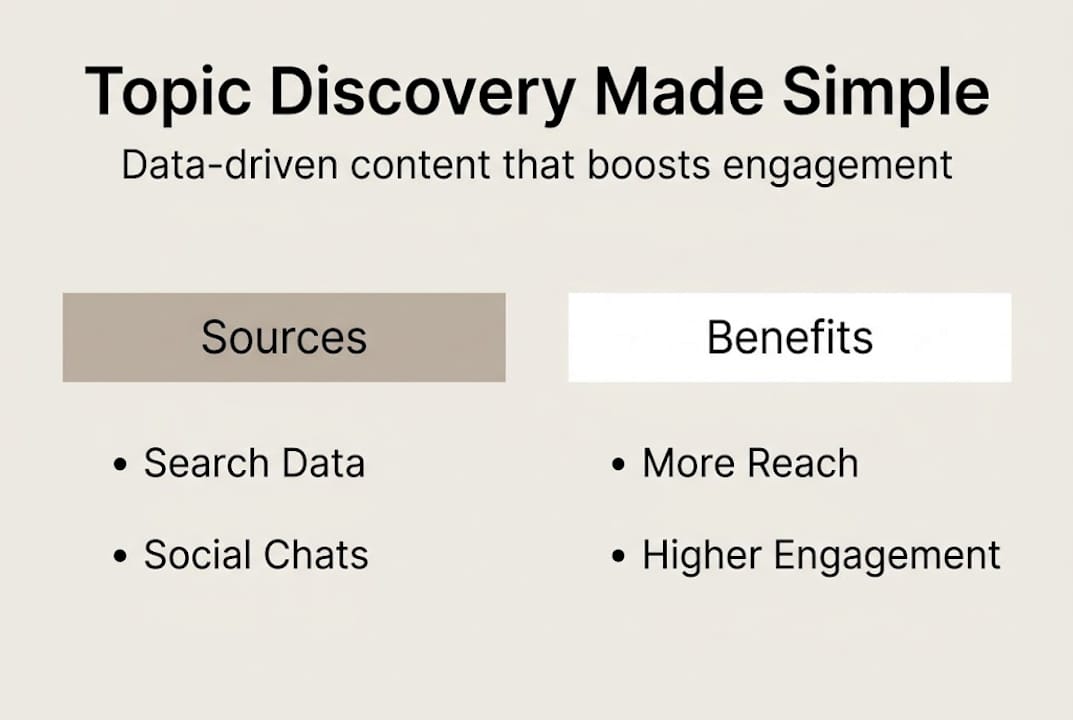
Topic discovery uses real-time data from search queries, social conversations, forums, and other signals to identify what audiences are actively seeking. It replaces the question "what do I think they want?" with "what are they already asking for?"
For African entrepreneurs building brands and communities online, this is foundational. Local markets move fast. Fintech, agritech, and edtech conversations shift weekly. If your content strategy is built on quarterly brainstorming sessions, you are already behind.
The signals that power topic discovery include:
- Search queries and autocomplete data
- X (Twitter) trending hashtags and threads
- LinkedIn group discussions and comment sections
- Reddit, Quora, and niche forums
- Sales call transcripts and customer support questions
- WhatsApp community discussions
"Content teams that skip structured topic discovery miss up to 68% of high-potential topics that traditional keyword tools never surface" — a reality that costs brands real audience reach and revenue.
The payoff for getting this right is significant. When your content answers questions people are already asking, engagement goes up, shares increase, and your community grows faster. Leveraging trending topics becomes easier when you know exactly which topics are gaining momentum before they peak.
For a deeper look at how trending conversations work in practice, the tech pro's guide to trending conversation breaks down the mechanics in plain terms. Tools like Semrush Topic Finder can help you get started with structured discovery right away.
How topic discovery works: methods and mechanics
Knowing what topic discovery aims to do is one thing. Understanding how it actually works gives you a real advantage.
The core methods behind effective topic discovery include:
- Semantic mapping: Grouping related keywords and concepts to reveal the full shape of a topic
- Question mining: Pulling real questions from forums, autocomplete, and community threads
- Intent classification: Sorting topics by what the audience wants to do (learn, buy, compare, solve)
- Citation potential scoring: Measuring how likely a topic is to earn links and shares
The step-by-step workflow looks like this:
- Gather signals from search tools, social platforms, and community forums
- Cluster related topics by theme and audience intent
- Score each cluster by engagement potential, competition, and relevance
- Validate top topics by testing with small posts or polls before full content production
AI identifies 4.7x more relevant topics than manual research alone, and 68% of high-citation content is missed by traditional keyword tools. That gap is where most content teams lose ground.

Semantic mapping and intent classification are now standard in leading content workflows, with tools like Semrush Topic Finder clustering keywords by intent to speed up the process.
Here is a quick comparison of the most useful tools:
| Tool | Best for | Strength |
|---|---|---|
| Semrush Topic Finder | Keyword clustering | Intent-based grouping |
| Ahrefs Keywords Explorer | Search volume analysis | Depth of data |
| BuzzSumo | Social content trends | Engagement metrics |
| AnswerThePublic | Question mining | Visual question maps |
| Keyworddit | Reddit topic research | Community-driven insights |
| Topic Intelligence | AI-powered discovery | Citation potential scoring |
Pro Tip: Do not rely on AI tools alone. Blend automated discovery with your own editorial judgment. AI finds scale. You provide cultural context and nuance that no algorithm can replicate.
For practical guidance on using discussion platforms for topic research, real communities are often your richest signal source. Staying current on discussion forum trends also helps you spot emerging topic clusters early. You can also explore finding content ideas directly within Semrush for a hands-on start.
Topic discovery for African social platforms and communities
Global topic discovery frameworks do not map perfectly onto Africa's digital landscape. The audience dynamics here are different, and your methods need to reflect that.
African tech communities on X (Twitter), LinkedIn, and WhatsApp have distinct patterns. Language switches between English, French, Swahili, Pidgin, and local dialects within the same thread. Topics around fintech regulation, mobile money, agritech innovation, and startup funding cycles drive outsized engagement. These are not niche interests. They are the core conversations your audience is already having.
Free tiers of Semrush and Ahrefs can surface local trends on X and LinkedIn effectively when you focus your social listening on African community spaces rather than global averages.
Here is how global tactics compare to Africa-specific approaches:
| Tactic | Global approach | Africa-specific approach |
|---|---|---|
| Hashtag research | Broad trending tags | Local tags (#AfricanStartups, #Fintech254) |
| Community listening | Reddit, Quora | WhatsApp groups, Telegram channels |
| Influencer signals | Global thought leaders | Regional founders and ecosystem builders |
| Platform focus | Google Search, Twitter | X (Twitter), LinkedIn Africa groups |
| Language targeting | Single language | Multi-language and code-switching content |
Practical ways to apply topic discovery in your African community context:
- Plan event content around trending local industry conversations
- Answer the FAQs your audience posts in community groups
- Identify underserved topics that global tools miss because the volume looks small
- Track local hashtags weekly to catch momentum before it peaks
- Monitor community platforms in African tech for first-mover topic opportunities
Pro Tip: Set aside 15 minutes every week for topic scanning. Weekly review beats quarterly planning every time in fast-moving markets. Use Semrush Topic Finder alongside local community listening for the strongest signal mix.
If you are building from scratch, the guide on launching discussions for African tech pros is a practical starting point.
Advanced strategies and expert pitfalls in topic discovery
Once you have the basics running, the gap between good and great comes down to how you handle scale, bias, and measurement.
One number worth knowing: automated content brief generation can reduce research time from three hours to eight minutes. That is not a small efficiency gain. It is the difference between publishing once a week and publishing every day.
But speed creates its own risks. AI discovery tools reflect the biases in their training data. If your tool was trained primarily on Western content, it will underweight African market signals. That is not a reason to avoid AI. It is a reason to stay involved in the process.
Discovery-driven content consistently shows lower production costs per engaged visitor, higher time-on-page, and stronger conversion rates. AI-discovered content earns 2.3 to 4.7 times more citations than content built on manual research alone. Those are real business outcomes, not vanity metrics.
Steps to avoid the most common pitfalls:
- Check for bias: Review your tool's data sources. If African markets are underrepresented, supplement with local community listening
- Add editorial judgment: Use AI to find topics, then apply your own understanding of your audience's culture and context before publishing
- Measure what matters: Track engagement, time-on-page, and conversions, not just raw views or impressions
- Avoid overfitting: Do not chase every micro-trend. Focus on topics with sustained audience interest
- Revisit your process: Topic discovery is not a one-time setup. Treat it as an ongoing workflow
Pro Tip: Optimize for engagement and conversion from the start. A topic that drives 500 meaningful interactions beats one that gets 5,000 passive views every time.
For community managers, moderating community discussions effectively becomes much easier when your topics are already aligned with what your audience cares about. You can also explore using AI for content briefs to speed up your production workflow once your topic pipeline is solid.
Why topic discovery changes the content game for African tech leaders
Here is something most guides on this topic skip entirely. Topic discovery is not a research task you complete and move on from. It is an ongoing conversation with your ecosystem. The moment you treat it as a one-time project, you fall behind.
Africa's tech communities evolve fast. A topic that dominated X (Twitter) last month may be irrelevant today. The founders and developers building here need discovery systems that run continuously, not campaigns that reset every quarter.
The real edge is not the tool you use. It is what you do with the output. Leaders who combine AI-driven discovery with genuine understanding of their local community culture create content that feels authentic, not algorithmic. That authenticity is what builds the kind of trust that turns followers into active community members.
Most people treat discovery as a content function. The best operators treat it as a community intelligence function. When you know what your audience is thinking before they say it, you show up with the right answer at the right time. That is how African community platforms build lasting engagement rather than chasing one-off viral moments.
Kickstart your topic discovery journey
Ready to move from guessing to knowing? Topic discovery gives you a clear, repeatable path to content that your audience actually wants. Whether you are launching a product, building a community, or growing your professional network, starting with the right topics makes everything else more effective.

Discors.chat is built for exactly this kind of work. It is a real-time discussion platform where African founders, developers, and entrepreneurs share ideas, follow trending conversations, and connect around the topics that matter most. Sign up with Google or Apple and start discovering the conversations your community is already having. Your next best content idea is already out there.
Frequently asked questions
What sources power effective topic discovery?
Effective topic discovery pulls from search data, social listening, community forums like Reddit and Quora, sales transcripts, and customer reviews as its core signals. The strongest strategies combine multiple sources rather than relying on any single input.
Which tools are best for topic discovery on African social platforms?
Free and paid tiers of Semrush, Ahrefs, and Keyworddit are highly effective, especially when paired with local community listening on X (Twitter) and LinkedIn Africa groups. Topic Intelligence adds AI-powered citation scoring for deeper analysis.
How often should topic discovery be performed?
A continuous or weekly approach is far more effective than quarterly reviews, particularly in fast-moving African tech markets where trends shift rapidly. Short weekly scans keep your content pipeline aligned with current audience interests.
Can AI-based topic discovery fully replace manual research?
No. A hybrid approach works best, with AI handling volume and pattern recognition while human judgment provides cultural context, brand alignment, and editorial accuracy. Neither method alone delivers optimal results.