
Many tech professionals default to asynchronous communication, believing it’s always more efficient. Yet research reveals a surprising truth: live conversations enable 3.1x faster task completion and dramatically reduce errors compared to messaging platforms. For entrepreneurs and developers navigating complex projects, real-time discussions accelerate decisions, strengthen trust, and unlock collaboration opportunities that async methods simply cannot match. This guide explores when and how to leverage live conversations for maximum impact in your tech work.
Table of Contents
-
How live conversations accelerate decision-making and reduce errors
-
Building strong professional relationships and trust through live networking
-
When to choose live conversations versus asynchronous communication
-
Maximizing ROI and business improvement through live peer discussions
Key takeaways
| Point | Details |
|---|---|
| Speed and accuracy | Live conversations complete tasks 3.1x faster with 47% fewer errors than async messaging. |
| Trust building | Real-time networking creates deeper professional relationships and higher quality connections. |
| Strategic timing | Choose live for high-nuance tasks and async for global teams across many time zones. |
| Business ROI | Video conferencing delivers 348% ROI and $11,000 annual savings per employee. |
| Peer learning | Structured live discussions transfer crucial knowledge and drive innovation among entrepreneurs. |
How live conversations accelerate decision-making and reduce errors
When you’re troubleshooting a critical bug or brainstorming product features, every minute counts. Research shows that synchronous video and audio exchanges speed up task completion by 3.1x compared to email threads or Slack messages. Even more impressive, error rates drop by 47% when teams communicate live rather than asynchronously. This isn’t just about speed; it’s about getting things right the first time.
Live communication shines brightest during high-nuance activities. Complex technical discussions benefit from immediate clarification, real-time feedback loops, and the ability to read vocal tone and visual cues. When you’re explaining architecture decisions or negotiating feature priorities, these elements prevent the misunderstandings that plague text-based exchanges. A five-minute video call often resolves what would take hours of back-and-forth messages.
Task completion comparison:
| Communication Method | Average Completion Time | Error Rate |
|---|---|---|
| Live video/audio | 1x (baseline) | 53% of async baseline |
| Asynchronous messaging | 3.1x slower | 100% (baseline) |
| Email threads | 3.5x slower | 110% of baseline |
Structure transforms good live conversations into exceptional ones. Set clear agendas before calls and impose time limits to maintain focus. Research on meeting efficiency shows that sessions under 25 minutes keep participants engaged without triggering fatigue. When everyone knows the objective and timeline, discussions stay productive rather than drifting into tangents.
Pro Tip: Start each live session by stating the specific decision or outcome you need. This frames the conversation and helps participants prepare relevant input immediately.
Avoid the trap of defaulting to live for everything. Unstructured marathon calls drain energy and reduce effectiveness. Reserve synchronous time for decisions requiring immediate consensus, creative problem-solving, or relationship building. For status updates or information sharing, async methods work perfectly fine. Platforms like Discors enable structured live discussions that balance efficiency with genuine interaction.
The productivity gains compound over time. Teams that master when and how to use live conversations make faster progress, ship with fewer bugs, and spend less time fixing miscommunications. That efficiency advantage becomes a competitive edge in fast-moving tech markets.
Building strong professional relationships and trust through live networking
Quantity doesn’t equal quality in professional networking. You can collect hundreds of LinkedIn connections without building a single meaningful relationship. Live conversations flip this equation by prioritizing depth over breadth. Research on networking effectiveness shows that 5 genuine live conversations create more business value than exchanging business cards with 50 people at a conference.
Trust forms through repeated, authentic interactions. When you speak with someone face-to-face or via video, you pick up on enthusiasm, expertise, and authenticity that text messages conceal. These subtle signals help you identify potential collaborators, advisors, or co-founders who share your values and vision. For entrepreneurs building teams or seeking partnerships, this trust foundation proves essential.

The conversion data tells a compelling story. Face-to-face or video-first interactions produce 3.8x higher referral conversion rates compared to LinkedIn direct messages. When you’ve had a real conversation with someone, they remember you, understand your work, and feel comfortable making introductions. Cold outreach rarely achieves this level of connection.
Why live networking outperforms digital-only approaches:
-
Real-time dialogue reveals personality and communication style
-
Immediate Q&A clarifies mutual interests and opportunities
-
Vocal tone and body language build rapport faster
-
Shared live experiences create memorable touchpoints
-
Follow-up feels natural rather than transactional
“The camaraderie and trust built through genuine live conversations form the foundation of successful business relationships. Quality interactions always outweigh superficial contact collection.”
Video conferencing democratizes access to quality networking. You don’t need expensive conference tickets or international travel to connect with thought leaders and potential partners. Schedule 20-minute video chats with people in your industry, share insights, and explore collaboration opportunities. This approach works especially well for tech professionals who can demonstrate their expertise through screen sharing and live demos.
Networking efficiency improves dramatically when you replace text-based cold outreach with video requests. Instead of sending 50 generic LinkedIn messages hoping for 2 responses, identify 10 highly relevant contacts and propose brief video introductions. Your response rate climbs because the ask feels more personal and the time investment appears manageable. Platforms focused on professional networking through live discussions facilitate these quality connections.
The relationships you build through live conversations tend to last longer and generate more mutual value. When both parties invest time in real dialogue, there’s implicit commitment to the connection. This differs fundamentally from passive social media following, where engagement remains shallow and forgettable.
When to choose live conversations versus asynchronous communication
The sync versus async debate isn’t about picking a winner; it’s about matching communication mode to context. Synchronous communication excels in immediacy and relationship building but carries risks when overused. Understanding these trade-offs helps you optimize team productivity without burning everyone out.
Live conversations make sense when you need instant feedback, collaborative problem-solving, or trust development. Brainstorming sessions, technical troubleshooting, negotiation, and onboarding new team members all benefit from real-time interaction. The immediate back-and-forth accelerates understanding and prevents the delays inherent in message-based communication.
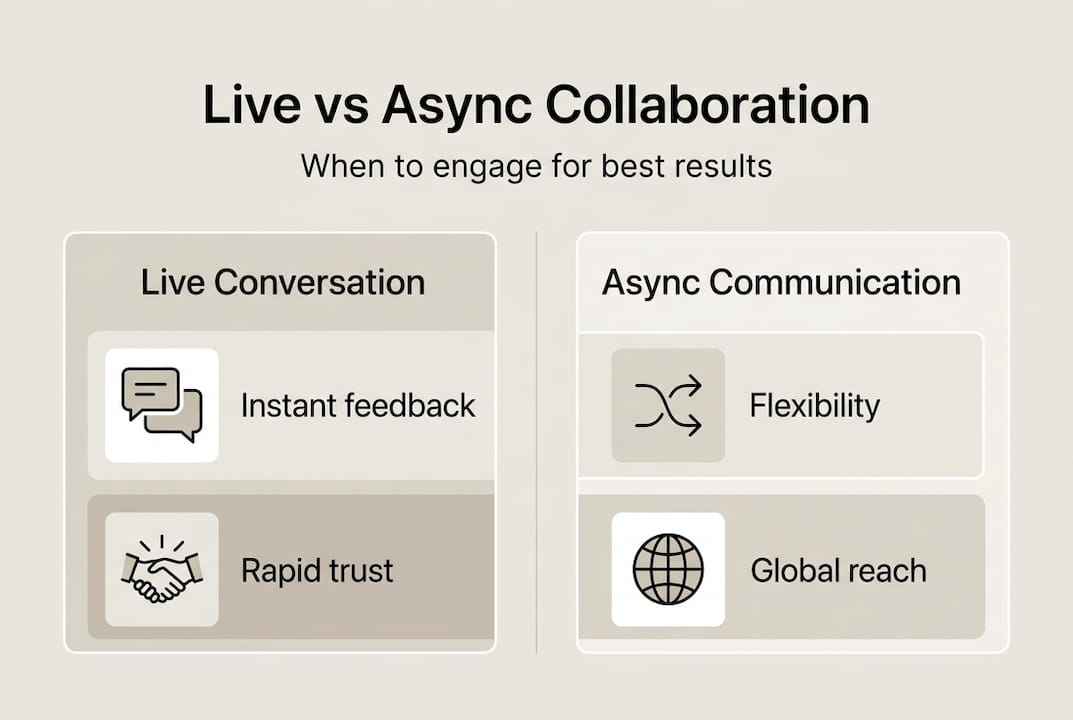
Async communication shines for globally distributed teams spanning more than 8 time zones. Forcing everyone onto simultaneous calls creates scheduling nightmares and guarantees some participants join at inconvenient hours. Written updates, recorded videos, and threaded discussions let people contribute when they’re fresh and focused. This flexibility particularly matters for teams balancing deep work with coordination needs.
Communication mode selection framework:
| Situation | Best Mode | Reason |
|---|---|---|
| Complex technical decision | Live (video/audio) | Requires immediate clarification and consensus |
| Status update | Async (written) | Information sharing without discussion needed |
| Creative brainstorming | Live (video preferred) | Benefits from rapid idea building and energy |
| Documentation review | Async (comments) | Allows thoughtful feedback at individual pace |
| Team building | Live (video/in-person) | Trust develops through real-time interaction |
| Global team coordination | Async (recorded updates) | Respects time zones and enables flexibility |
Meeting fatigue represents a real danger. Data shows that unstructured long calls increase fatigue by 39%, with meeting time jumping 252% in many organizations. Combat this by imposing strict agendas and time limits. If a discussion doesn’t require live interaction, default to async. Your team’s energy and focus are finite resources.
Pro Tip: Implement a “live or async” decision checklist before scheduling any meeting. Ask whether the topic requires immediate feedback, involves multiple stakeholders who need to align, or builds relationships. If the answer is no to all three, choose async.
Some high-stakes trust building may require in-person interaction beyond video calls. While video works well for most professional relationships, closing major deals or forming co-founder partnerships sometimes benefits from physical presence. Recognize this limitation and plan accordingly for your most critical connections.
Balance prevents the silos and misalignment common in async-heavy cultures. Teams that never talk live struggle with cohesion and shared understanding. Conversely, organizations addicted to meetings waste time and frustrate individual contributors. Platforms designed for moderated live discussions help strike this balance by structuring synchronous time effectively.
Guidelines for balanced communication:
-
Reserve live time for decisions, creativity, and relationship building
-
Use async for updates, documentation, and individual work coordination
-
Limit live sessions to 25 minutes unless absolutely necessary
-
Record important live discussions for team members in other time zones
-
Establish team norms about response time expectations for async messages
The right balance varies by team composition, project phase, and organizational culture. Experiment with different ratios and gather feedback regularly. What works for a 5-person startup differs dramatically from a 50-person distributed company.
Maximizing ROI and business improvement through live peer discussions
The financial case for video conferencing is remarkably strong. Research reveals that video conferencing delivers 348% ROI over 3 years, with companies saving $11,000 annually per employee through reduced travel costs. Productivity gains reach 25% as teams eliminate commute time and access expertise regardless of location. For tech companies operating on tight budgets, these savings fund additional hiring or product development.
Weekly live entrepreneur peer calls create outsized value through knowledge transfer and innovation. Virtual peer discussion groups improve business practices and accelerate digital adoption, particularly among founders in emerging markets. When entrepreneurs share challenges and solutions in real time, they learn from each other’s experiments without repeating costly mistakes. This peer learning compounds over months into significant competitive advantages.
Video conferencing impact metrics:
| Metric | Improvement | Source |
|---|---|---|
| ROI over 3 years | 348% | Industry analysis |
| Annual savings per employee | $11,000 | Travel cost reduction |
| Productivity increase | 25% | Time efficiency gains |
| Meeting effectiveness | 3.1x faster decisions | Task completion studies |
Live peer discussions enhance digital adoption in ways that recorded content cannot match. When someone demonstrates a new tool or technique live, participants ask questions immediately and see real-world application. This interactive learning sticks better than watching tutorials alone. Tech startups leveraging peer learning communities ship features faster and make smarter technology choices.
Choosing the right platform amplifies these benefits significantly. Look for solutions offering reliable video quality, screen sharing, recording capabilities, and moderation tools. Security matters enormously when discussing proprietary technology or business strategy. Platforms purpose-built for professional discussions typically outperform consumer video chat apps.
Key platform features for effective live discussions:
-
High-quality video and audio with minimal latency
-
Screen sharing for technical demonstrations
-
Recording and transcription for async review
-
Moderation controls to maintain productive dialogue
-
Integration with collaboration tools
-
Strong security and privacy protections
Media professionals and tech startups demonstrate the practical value of structured live conversations. Design teams conducting live critique sessions iterate faster than those relying on async feedback. Developer communities hosting live coding sessions help members level up skills rapidly. Sales teams running live demo practice sessions close deals more effectively.
The ROI extends beyond direct cost savings into harder-to-measure benefits like employee satisfaction and retention. Remote workers who participate in regular live team discussions report feeling more connected and engaged. This social connection reduces turnover, which saves recruiting and training costs. For tech companies competing for talent, fostering genuine connection through live interaction becomes a retention strategy.
Explore networking platforms designed for entrepreneurs to find communities matching your industry and goals. Many offer structured peer discussion formats that maximize value while respecting your time. Some platforms specialize in specific niches like SaaS founders, mobile developers, or AI researchers, which increases relevance and actionability of insights shared.
Consider video conferencing alternatives if your current tools lack features or reliability. The market offers diverse options optimized for different use cases, from large webinars to intimate peer groups. Testing several platforms helps you identify which interface and feature set best supports your communication style and team needs.
Explore secure live conversation solutions with Discors
After understanding the substantial benefits of live conversations for collaboration, networking, and business growth, the next step involves choosing a platform that delivers these advantages reliably. Discors provides tech professionals and entrepreneurs with a secure environment purpose-built for meaningful live discussions. The platform supports structured video and audio sessions designed to maximize engagement while maintaining the focus and productivity that busy professionals require.
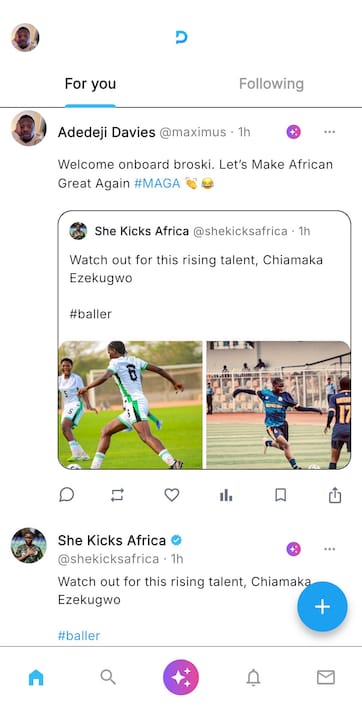
Whether you’re launching discussions with fellow tech professionals, exploring networking opportunities, or building communities around shared interests, Discors offers the tools and safety features that make quality conversations possible. The platform prioritizes privacy and active participation, helping you connect with innovators, collaborators, and potential partners in an environment free from the noise common on broader social platforms.
What are the main advantages of engaging in live conversations?
How do live conversations improve decision-making speed?
Live conversations enable teams to complete tasks 3.1x faster than asynchronous methods by providing immediate clarification and real-time feedback. This speed advantage proves especially valuable for complex technical decisions requiring input from multiple stakeholders. The reduction in back-and-forth delays means projects move forward without waiting hours or days for email responses.
Why do live discussions reduce errors compared to messaging?
Error rates drop 47% in live conversations because participants can ask clarifying questions immediately and confirm understanding before moving forward. Tone and context that get lost in text messages come through clearly in voice and video. This immediate feedback loop catches misunderstandings before they become costly mistakes in code or strategy.
What makes live networking more effective than collecting contacts?
Live networking prioritizes quality over quantity, with research showing 5 genuine conversations create more value than dozens of superficial connections. Face-to-face or video interactions build trust through authentic dialogue and allow both parties to assess mutual interests accurately. These deeper connections lead to 3.8x higher referral conversion rates compared to text-based outreach.
When should teams choose live conversations over async communication?
Choose live for high-nuance tasks like brainstorming, troubleshooting, negotiation, and relationship building that benefit from immediate interaction. Reserve async for status updates, documentation review, and coordination across many time zones where flexibility matters more than immediacy. The key is matching communication mode to the specific needs of each situation rather than defaulting to one approach.
How do virtual peer discussions improve business outcomes?
Virtual peer discussion groups accelerate learning by letting entrepreneurs share real-world experiences and solutions in real time. Participants avoid repeating others’ mistakes and discover proven strategies faster than learning alone. This collaborative knowledge transfer drives innovation and improves business practices, particularly for founders in emerging markets building tech companies.
What ROI can companies expect from video conferencing investments?
Video conferencing delivers 348% ROI over three years through travel cost savings averaging $11,000 per employee annually and 25% productivity gains. These financial benefits stem from eliminating commute time, enabling faster decisions, and providing access to expertise regardless of location. For tech companies, these savings can fund additional hiring or accelerate product development timelines.